Direct Instruction’s limits: A nuanced look at Engelmann’s ideas
When Engelmann developed his popular Direct Instruction1, his principle was that students were capable of learning anything. This seems like a good rule to follow; it removes blame from the student. If they didn’t manage to learn something, it was because it wasn’t explained well enough. It inspires us to rework and reword and adapt our explanations.
But, Engelmann’s views were more unusual than this, because, while they had one foot in the cognitive, the other was in behaviourism.
Behaviourism ignored the mind and focused entirely on the response (the behaviour) to stimuli. If you were to draw a student with this theory, it’d look like this:
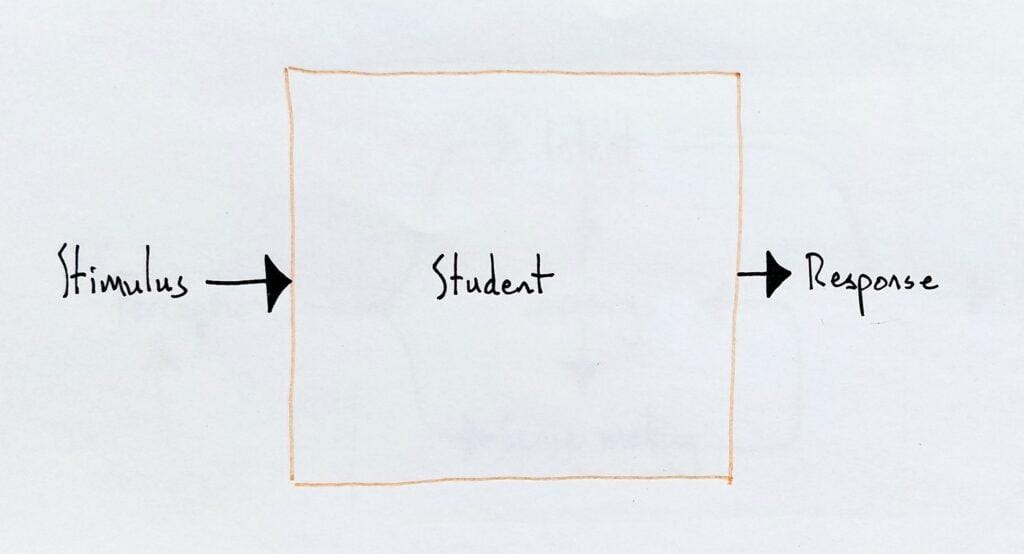
Things like making meaning weren’t of interest to the behaviourist. All that mattered was the response. And as Engelmann’s work had one foot in behaviourism, he was interested in developing explanations that would give predictable responses.
The response he intended to cause was the generalisation of an idea over different examples. For example, once you’ve seen one pear, you can spot others despite changes in shape or colour.
Those stimuli that could cause predictable responses, he called faultless communications. His objective was: “to design communications that lead to only a single generalization or interpretation … a communication should be faultless.”
This “should be faultless” sounds like a nice goal that teachers should strive for, but which everyone knows deep down isn’t possible. This wasn’t the case for Engelmann; he believed that communication could be faultless (you’ll see why in a moment). He even gave a set of criteria for designing it.
Behaviourism with logical cognition
While Engelmann had one foot in behaviourism, he placed the other in the cognitive. He wasn’t happy that behaviourism couldn’t account well for generalising concepts across new examples.
To make up for it, he made an interesting move. He looked at the logic of induction and applied it to learning. He would later compare this to the rules designed for scientists seeking the physical cause of a phenomenon in a laboratory, as if the mind worked in the same way.
Scientists meticulously design experiments to isolate variables and draw valid conclusions. Engelmann believed teaching could be the same: the teacher acts as the scientist, designing a communication that perfectly isolates a concept, and the student acts as the observer who automatically sees the logic and generalises it.
Engelmann, therefore, rejected the notion that students were just the reflex machines of behaviourism, simply associating stimuli and responses. This wasn’t enough for education, he thought. Instead, Engelmann built his pedagogy on a fundamental assumption: students functioned as predictable logic machines. He argued: “although the mind is perfectly logical in design, it needs particular kinds of input if it is to apply its logical operations.” If fed with the right data, students would give the right generalisation.
In this light, his focus on “faultless communication” makes sense. If students were logical machines, and were provided with perfect logic, the communication ought to be faultless. However, as Warren McCulloch2 pointed out, the mind doesn’t necessarily follow classical logic. Consider this:
If a person:
Prefers bananas (B) over apples (A),
And prefers cherries (C) over bananas (B),
Classical logic would determine that they would prefer cherries (C) over apples (A), like this: Apple < Banana < Cherry.
Yet, in reality a person may still prefer an apple (A) over a cherry (C). This breaks the logic by giving a paradox: Apple < Banana < Cherry < Apple.
The mind, then, can’t be reduced to a logic machine. Just as personal context overrides classical logic when choosing a fruit, a student’s meaning making mind will reshape the “faultless logic” of a teacher’s lesson.
As I read Engelmann’s writing, however, it appears he had to confront this problem with his own students. Despite his insistence that “a communication that is analytically faultless is faultless for any learner”, he also admitted (somewhat discordantly) that logic wasn’t enough. This was because, he said, “it assumes that the students respond correctly to all the examples in a set that is designed to generate only one inference”.
This points to the limitations of treating the mind as a logic machine: when human minds don’t play by the logic rules, the pedagogy resorts to behaviourist conditioning; more practice producing the correct generalisation, with some needing more than others. Nevertheless, this appears to be a reliable move in highly-structured domains such as phonics and maths.
Where does Direct Instruction work?
Engelmann’s work was observed in a major study. It was aimed at bringing disadvantaged pre-schoolers up to the performance of middle-class students and completely out-performed the other experimental models. With these academic gains, the students’ self-esteem also vastly improved. There are videos of Engelmann showing how warm he was with his students and how interactive and conversational his lessons were.
Engelmann’s model appears to work very well for teaching highly specific, tightly defined and structured concepts, like phonics and spelling, and aspects of maths (something I’ll return to in a moment). Especially so, when predictable outputs are measured as successful.
His model also urges communication to leave no ambiguities, a good objective. And, if it doesn’t work out, the burden is on the teacher to work out the problem in a continual loop. In general, Engelmann had an unwavering belief that any student could learn to read and do maths. He thought that learning disabilities in these areas were often due to “teaching disabilities”.
Engelmann also had a strong focus on repetition. He recommended that every lesson spend the vast majority of time on review and repetition, introducing very little new content. And in his methods, students would practice until mastery (with some students needing more than others). Eventually, with enough repetition (with stimuli and response) we’d expect students to give predictable performances. So, where does it fail?
The limits of unstructured domains and meaning
This predictable performance works incredibly well in areas of structured concepts like phonics and maths. These are fields that come with pre-made distinctions structured into their symbols (letters and numbers). Here, Engelmann’s induction succeeds because these are often areas with which students have familiarity (e.g. speech and quantity). The method involves logically mapping familiar (but maybe vague) ideas onto formal pre-distinguished symbols within a structured system.
It makes sense for my young son to map his understanding of the “b” sound to the “b” symbol and practice reading it until he routinely distinguishes it from the “d” symbol. The purpose of teaching phonics is also, of course, to have students follow procedures logically to give consistent and reliable outcomes.
Proponents of Engelmann could argue that his work also succeeded in unstructured domains, such as courses on reasoning and writing. However, to achieve this, Direct Instruction structures these domains so that following logical procedures gives the desired outputs. When students don’t give that predicted output, Engelmann suggested that “the answer provides information about the amount of practice they need”.
But what happens in unstructured domains and when the goal isn’t to give predictable outputs? Maths teachers tell me of highly successful students (at calculating correct outputs) that struggle when asked to explain their thinking.
And, personal conversations with teachers of less-structured and complex domains have often revealed confusion over how to apply Engelmann’s methods. What exactly should a student in history or biology practise if they give an answer the teacher hadn’t expected?
I’ve witnessed secondary biology curricula reduced to “telling and quiz practice” to ensure students respond correctly. In my experience, students who excel on recall quizzes can flounder spectacularly in a conversation requiring them to explain and predict the world they live in. They simply don’t know what they mean.
Note: If you’ve experienced this frustration, navigating this problem is exactly what I explore in my book, Teaching Meaning: What Works When Telling Isn’t Enough.)
The missing mind in Engelmann’s work
Why do students flounder in these complex conversations despite performing perfectly on quizzes? This points to the limits of Engelmann’s pedagogy: the exclusion of the meaning making mind.
Engelmann thought his method was the way to teach in all circumstances, because he saw the mind as a vessel that simply mirrors data that exist in the world. He said that “concepts are not the property of the mind” and that when students fail, they fail to be “perfect mirrors” of the environment. As Engelmann stated in his own work:
The extent to which the learner’s performance deviates from the performance that would occur if the learner responded perfectly to the communication provides us with precise information about the learner. The deviations indicate the extent to which the learner is not a perfect “mirror” of the environment.
Inner thoughts, intentions, meaning, etc., aren’t to be considered, because, he said, “stimuli are the agents that make a difference, and the differences that are made are the responses.”
In doing so, he bestows ultimate power to the teacher. Their faultless communication is designed to override any personal sense making to guarantee a specific output. What happens, then, when a student doesn’t perform correctly? Engelmann says:
If the learner does not respond in the predicted manner to a faultless communication, the assumed “fault” lies not with the communication, but with the learner … [When this occurs,] we must switch our focus … to the laws of behavior. These laws provide us with specific guides about the amount of practice, the massing and distribution of trials, the schedules of reinforcement, and other variables that cause the growth or strengthening of the learner’s response to take place.
The laws of behaviour suggest how to standardise behaviour through reinforcement. He elaborates with an example:
For example, if the learner apparently forgets the word red and cannot respond to various examples in a faultless presentation that asks the learner, “What color is this?”, we modify the learner’s capacity to “remember” how to produce the name. When the learner reliably remembers the words, we return to the original communication. The learner is now assumed to be an adequate receiver, capable of responding according to the predictions of the stimulus-locus analysis.
Engelmann doesn’t view deviations as a sign of alternative sense-making, but as an error in the logic machine. Confronted with unpredictable students, his method is simply to return them to a predictable state: just keep practising until you get the desired response from a chosen stimulus.
Engelmann was clearly a clever man who cared immensely about education and the students he taught. Yet, his ideas are limited in scope by the exclusion of the meaning-making mind. I can’t help but wonder what we might have gained had Engelmann not been constrained by the era of behaviourism. And what he could have achieved had he spent time extending his ideas into highly unstructured domains?
The induction problem
Because Engelmann believed concepts exist out in the environment, the mind could be abstracted away. This allows his key move: the presumption that students can already recognise those features.
This assumption leads Engelmann to see all learning as induction: recognising the pre-existing features of the world and generalising them. It suggests that humans parachute into a world already full of concepts that we must simply gather.
However, if you add the meaning-making mind, induction has hard limits: it can work fine if you can already recognise the features. It’ll struggle if you have not yet recognised, distinguished, or told them apart from everything else.
For example, how could the mathematical concept of “zero”, or the social idea of “marriage” exist before humans conceptualised them? At some point in human history, these concepts had to be brought forth by human minds making sense of the world. While they now exist in our social world, individuals still need to make meaning of them.
This, for me, determines the limits of Engelmann’s model: it doesn’t explain how students can perceive something entirely new to them. He relies, instead, on “examples and nonexamples”.
These certainly have a use. Examples show what something looks like. Then nonexamples establish a rule denoting its boundary, which prevents students generalising beyond it.
Engelmann’s method, therefore, relies on the teacher defining a logical boundary. The assumption is that if a student can successfully sort items inside or outside that boundary, they understand the concept.
This move may work in highly-structured domains with logical symbols (like phonics and maths), and especially when producing predictable outputs is the goal. For example, I agree with Engelmann that a clever sequence of examples of prime numbers and nonexamples of prime numbers can quickly prompt students to learn the difference and generalise the idea.
But I can’t do the same for the biological concept of cells, as fundamental as they are. A set of examples of “cells” and “not cells” might help them identify simple pictures of cells, but it doesn’t prompt them to make sense of what cells are and their meaning for living organisms.
Far from mysterious, it makes perfect sense when we realise that generalisations (what’s similar, what’s not) and meaning are not “out there” in the environment. They’re something we must bring forth in our minds and agree upon through conversing with others.
Engelmann’s pedagogy, therefore, abstracts away a step that we must recognise: bringing forth a meaning in the students’ mind. This can’t be skipped when students must distinguish something completely unbeknownst to them; something they don’t yet perceive and, therefore, isn’t part of their world.
Successfully navigating the teacher’s boundaries of concepts can lead to much success in highly-structured domains. But it’s not the same as students perceiving a concept’s meaning and it becoming part of their world.
Think about those eureka moments, those flashing insights, when you suddenly see something in a new way.3 You bring forth a new idea in your mind. Engelmann’s theory can’t explain this. There’s no place for students to draw new insights when they are destined to become “perfect mirrors” of the pre-existing examples that surround them.
The unpredictable meaning maker
So, if students aren’t just mirrors or predictable logic machines, what are they? In addressing the issue of human predictability, Heinz von Foerster (the precursor of enactive cognitive science) created a model in a diagram. I’ve translated his idea into the following graphic:
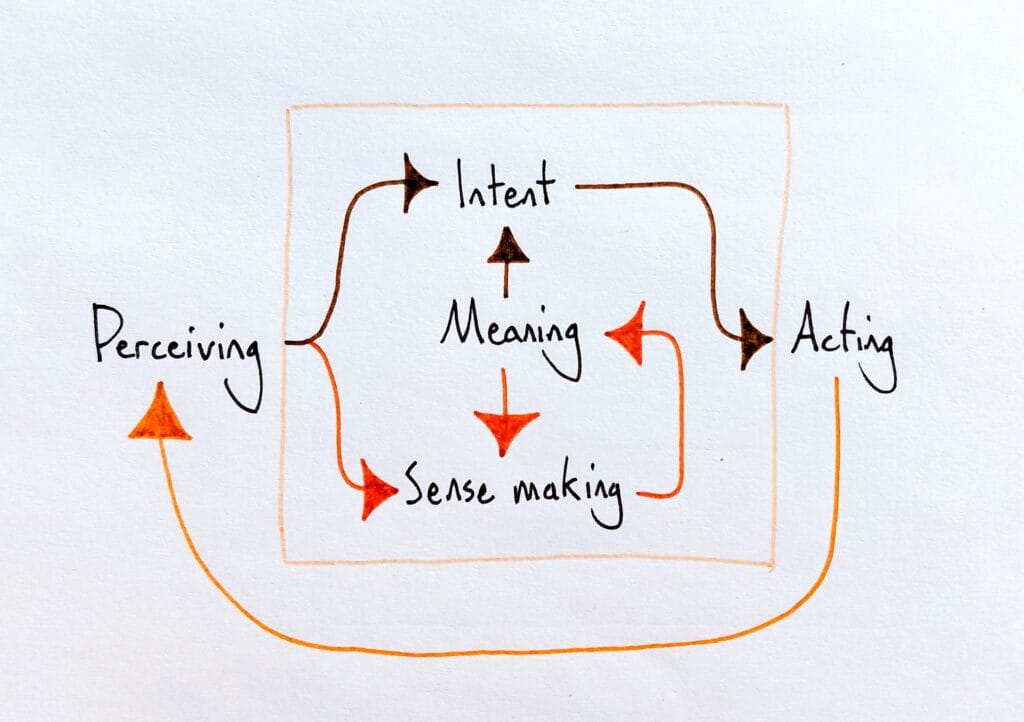
Engelmann’s model just considers the “logic” of the stimulus as determining the response. He said that, “an inference is based solely on the features of the examples that are presented”. And, he thought, the mind wasn’t the agent; “stimuli are the agents that make a difference, and the differences that are made are the responses.” (emphasis added).
Notice how in von Foerster’s diagram, the person’s intent depends on more than just their perception; it also depends on the meaning they’ve already made. At the same time, the way they actively make sense of the situation draws on that very same meaning.
Meaning, then, is central to the model and point to a key distinction. Engelmann argued that students were logic machines; thinking perfectly logically with the logical environment. In this model (and that of enactive cognitive science and variation theory), students think perfectly rationally with the meaning they’ve made.
The most interesting bit comes next: notice how the sense-making actively updates the meaning people hold.
According to the model, then, when our students perceive something and act in response, we may then think, “hey, they learnt it, they should now respond in the same way if I give them the same stimulus”. This was Engelmann’s idea.
But every time the student perceives something, their meaning is updated in some way. The next time we ask them the same question, we may get something different, something we didn’t expect.
On the outside, there’s another loop to consider. As students act, they perceive new things. For example, as they answer a question, they perceive our response to them: our body language, our words and tone. They also perceive their classmate’s responses. They make sense of this and continually update their meaning.
Conversation brings us closer
When asked to explain why people in our lives appear to be somewhat predictable, Heinz von Foerster’s answer brings us closer to understanding another reason Direct Instruction was successful.
He was interested in that external loop: when we act, it causes others (and the world) to respond, and that feeds back into our perception. Conversation works this way. We go round and round in loops, perceiving and responding. When we don’t understand each other, or we express ourselves badly, or when we get a reaction we didn’t expect, we reword and rework our expressions.
Over time, we come to understand and adapt to each other. We come to terms. This is, of course, the story of the classroom as weeks go by. And through this process, of a mutual coupling of minds, we begin to think more alike. It’s through conversation (that continual back-and-forth interaction) that we can come to agree on the distinctions we’ve made; the things that matter to us.
This is a major goal of our classroom. I want my students to think like biologists, something I continually model and encourage with students. Over time, they come to predict what I’ll say and make jokes about my catch phrases. They’re learning to perceive the distinctions that a community of biologists have made. In this sense, they aren’t gathering logical concepts from their environment; they’re learning their teacher’s way of understanding and the meaning they’ve made of the content.
This is where we should look most closely at Engelmann’s work. His focus on clear explanations was revolutionary. His nonexamples are a useful tool for tidying up definitions and his emphasis on practice is one to always keep in mind.
But the real highlight, for me, was Engelmann’s warm, highly conversational manner with his students and his endeavour to include and hear all students in the classroom. This enables us all to align the distinctions and meaning we make.
However, when we recognise that the student’s mind is a meaning-maker, not a mirror, the goal of that conversation shifts. Beyond those highly-structured domains (like phonics), it’s no longer for ensuring a predictable response but for generating new perceptions and agreeing upon a meaning.
The question is, then, if Direct Instruction gives you the tools for tightening definitions of something somewhat familiar, how do we actually help the student perceive and recognise something new in the first place? For this, there is a practical tool given to us by variation theory.
Followers of Engelmann often consider variation theory an application of Direct Instruction. As I explain in Teaching Meaning, however, the use of nonexamples is, ironically, a nonexample of variation theory. They are superficially similar but fundamentally distinct.
Direct Instruction begins with logic and induction as if concepts pre-exist our ability to perceive them.
Variation theory begins before induction: with the meaning-making mind that must first recognise and distinguish. Rather than showing what something is and what it isn’t, variation theory urges us to first vary the idea itself to trigger students into perceiving it, and follow with conversation to agree on a meaning.
When teaching the heart’s functioning, for example, it isn’t enough to just logically point to “functioning” and “not functioning.” Instead, one must vary the heart: showing valves that are normal, narrowed, and entirely absent, and conversing over the differences those specific variations make to the organism.
Nonexamples build a logical fence around a definition. Variation triggers the student to bring forth the meaning of the valve in the first place. Yet, there’s no place for students to draw these new insights when their fate is to simply become “perfect mirrors” of pre-existing examples.
If you want to move beyond just “building fences” around definitions, we have to change how we teach. To discover exactly how to trigger new learning using variation, navigate unpredictable minds, and develop a shared way of being in your classroom, grab a copy of my book: Teaching Meaning: What Works When Telling Isn’t Enough.
References
Engelmann, S., and Carnine, D. 1991. Theory of Instruction: Principles and Applications.
USA: NIFDI Press.
Engelmann, S., and Carnine, D. 2011. Could John Stuart Mill Have Saved Our Schools? USA: Attainment Company.
Foerster, H.von, and Poerksen, B. 2002. Understanding Systems: Conversations on
Epistemology and Ethics. New York: Kluwer Academic/Plenum Publishers.
Foerster, H.von. 2003. Understanding Understanding: Essays on Cybernetics and
Cognition. USA: Springer-Verlag.
Marton, F. 2015. Necessary Conditions of Learning. London: Routledge.
Notes
- All citations in this post are from Engelmann and Carnine’s two books: Theory of Instruction, and Could John Stuart Mill Have Saved Our Schools?. For brevity, I’ll only refer to Engelmann in the text. ↩︎
- McCulloch, W. 1945. “A heterarchy of values determined by the topology of nervous nets”. Bulletin of Mathematics Biophysics, volume 7, pages 89–93. ↩︎
- Ference Marton et al. (1994) analysed transcripts of discussions with Nobel laureates spanning 1970 to 1986. They found something key to their experiences: “the sudden insight that occurs without any obvious reasons at all, the pieces of the jigsaw puzzle falling into place, the sudden revelation of the solution.” (Marton and Booth 1997). Knowledge in this sense isn’t the acquisition of another knowledge token, but a new way of seeing. See, Marton, F., & Booth, S. 1997. Learning and Awareness. New York: Routledge; Marton, F., Fensham, P., & Chaiklin, S. (1994). A Nobel’s eye view of scientific intution: Discussions with the Nobel prize-winners in Physics, Chemistry, and Medicine (1970–1986). International Journal of Science Education, 16, 457–473.
↩︎