What Works When Telling Isn’t Enough?
Move beyond “teaching-to” and start genuinely connecting with your classroom.
Many teachers are left disenchanted by the myth of a single “best practice”. Teaching Meaning offers something different.
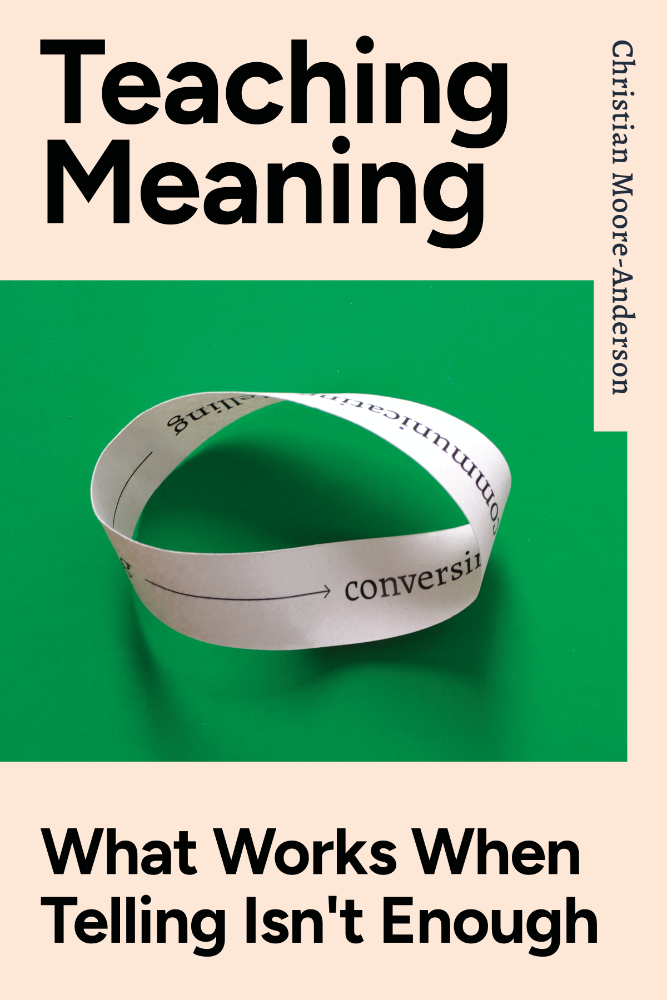
Grounded in the science of how humans make sense of the world, it reframes teaching as an evolving game built on five essential moves: Communicating, Conversing, Varying, Modelling, and Practising. These moves develop a dynamic, co-adaptive way of teaching where success comes from deepening, not perfecting, the conversation between teacher and learner.
Inside, you’ll learn how to use:
- Explanations to help students notice what truly matters.
- Questions as tools for revealing their underlying thinking.
- Variation as the key to moving beyond recall into real understanding.
- Modelling and Practice to turn new insights into lasting habits.
Discover a fresh way to think about meaning-making and find new ways to enjoy the living art of teaching.

A distinct perspective
In Teaching Meaning, Christian Moore-Anderson gets to the heart of how well-designed teaching can transform student learning. Writing with his distinctive perspective, he shows how many rules of thumb in teaching are half-truths. Greater clarity in our own thinking as teachers, along with a better understanding of what is needed in the minds of students if they are to learn, can make teaching much more effective.

A vital addition
The brain is a beautifully complex organ, and humans are inherently social beings. While education has recently embraced the science of memory, Christian’s book supports educators in taking the next crucial step: helping young people make meaning.
As an experienced, practising teacher, Christian guides the reader through the carefully curated moves of the ‘Meaning Making Game.’ This application of enactive cognitive science gives teachers a way of acting that generates deep understanding.
Every page is rich with insight. As I was reading, I felt compelled to talk to Christian about what I was learning – a perfect reflection of the coordinated meaning-making the book itself is about. As a vital addition to our educational dialogue, I wholeheartedly recommend this to readers in all areas and phases of education.