The problem with “teaching consistency”
Education is caught in a debate over autonomy and cohesion. On one side, teachers are demanding professional autonomy: the right to discretion over their lessons. Others are demanding “consistency” through rigid structures and scripts. Neither is fully right.
Professional autonomy is vital, but too much can result in the “siloed teacher”. The potential to create something greater through cohesive teaching and curricula is lost. But to understand the issue with “teaching consistency,” we must move past the binary of autonomy versus control. It’s more fruitful to look at a teacher’s autonomy versus collectively gained capacity.
A teacher’s autonomy versus collectively gained capacity
A graph will help, and through its analysis, I’ll show how some “teaching consistency” arguments don’t add up.
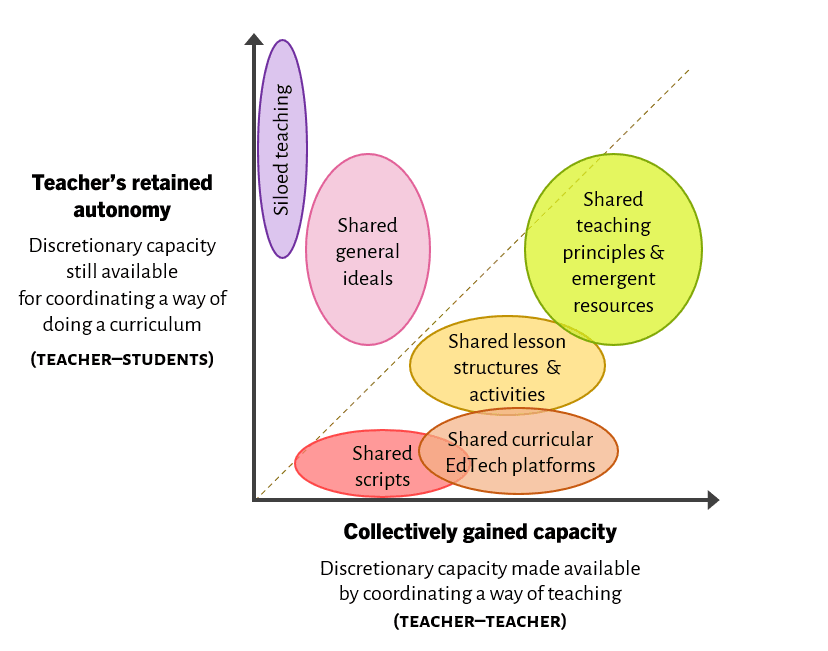
On the y-axis, you’ll find the teacher’s retained autonomy: the capacity to decide how to coordinate with their students. Specifically, it’s the discretion that has been retained (the variety of options still decidable by them) while working within a school (a collective). These may be options for how to teach:
- Can you slow the lesson down and not complete the summary activity?
- Can you decide to use your own resources?
- Can you dedicate more lessons to a topic?
- Can you choose a different text or demonstration, or write a different assessment?
On the x-axis, you’ll find the extra capacity that teachers gain when coordinating with other teachers or systems. When, for example, we enter a department and decide on a curriculum, we suddenly gain extra capacity to act through the collective designing and sharing of resources.
From here, I’ll explore the possible positions between these two axes. My commentary focuses on how a curriculum is enacted and assumes that the “what to teach” is already in place in some format.
Losing autonomy
Moving ↘ on the graph, we have the classic example of autonomy loss. From the siloed teacher or general ideals to shared scripts or shared “curricular EdTech platforms” (such as Oak Academy, Science Bits or Maths Bits). Those digital platforms within which students carry out their curricular activities.
The siloed teacher, despite their great freedom, loses out on sharing with other teachers. They don’t form part of a network that shares ideas and resources, which would benefit their capacity to act.
A shared EdTech platform, in contrast, can provide a network of aligned resources that we can assign rapidly. It may also provide us with vast data helping us pinpoint problems. We gain discretionary capacity, therefore, from coordinating with the shared platform. But, it also vastly reduces our autonomy. It locks us into its curriculum and activities, with little ability to modify it to our students’ needs, or our (the teachers’) collective vision.
This exact same trap occurs with rigid lesson scripting. I mean scripts here in a wide sense. They include lesson scripts (you must say this, or you must do this worksheet or activity), timings for lessons (you must complete this lesson by X time), and strict assessments (you will do Y assessment at Z time). The ability to adapt to classes and contexts is curtailed.
Scripts intend to remove the variation in teaching (in principle) aligning what and how teachers teach. By providing all resources, teachers have extra time available to work on other matters; this provides some collective capacity. This could be a life-saver for novice teachers and those teaching out of their specialism.
But it still comes at the cost of much potential. By having teachers comply with a strict way of teaching, they lose their ability to use their expert discretion. This reduction in variety is the goal of enforcing ways of teaching, but one that sits in tension with the principles of systems theory. Systems resilience and ability to adapt depends precisely on variety.
The loss of each teacher’s own specialist knowledge is a loss to the system. Over time it gets worse; it creates a deskilling-vortex in which that specialist teaching expertise is also lost from the system and teachers become dependent on scripts. Schools, then, loose capacity overall.
Removing autonomy removes conversation
Students and classes can vary wildly, and sudden insights and meanings can arise in different ways. Adaptation occurs in the interaction and solving of problems that arise. By curtailing the ability to adapt, therefore, we reduce the ability to converse, and the teacher can’t make those in-the-moment decisions to ensure they stay adapted to their students.
Likewise, teachers converse. They discuss what students have found difficult, and they discuss new visions and possible curricula. When everything is scripted, there’s no platform for such conversations. The capacity is capped at the level of the script author who doesn’t inhabit the specific contexts of our lessons or schools.
Shared lesson structures and activities retain some autonomy
As we move ↗, we leave scripting behind allowing teachers to retain some autonomy.
The next area consists of shared lesson structures and activities. Here, a school expects lessons to follow a particular pattern, with explicit starters and transitions. They ask teachers to follow the same routines and procedures. Exactly what is said during such activities is left to the discretion of the teacher. Conversation, therefore, is given room so teachers can adapt to their students’ unpredictable learning.
As we move ↗, teachers also gain more collective capacity. Despite much of their lesson structure being beyond their choice, they can now choose their phrasings and adapt their resources. The possibility of sharing with colleagues gains more meaning, and conversations arise around it. Coordination in this system allows teachers access to more, and varied, expertise, plus the potential to create new resources and ideas through collaboration.
But, problems remain. Why should a biology teacher follow the same lesson structures and pedagogical routines as an English teacher, and vice versa?
Coordination of learning isn’t a cost
Arguments for alignment often prioritise clear explanations, coherent curricular sequences, and efficient activities. They want to remove ambiguities and reduce any noise. But they rarely include the teacher themselves in the list of necessities.
Why is this problematic? It assumes that content is all that there is: that facts exist in the environment and must simply be acquired. It’s as if content exists beyond communities of practice. It’s assumed that teachers are just porters of acquired knowledge that can be transmitted to students. Yet, modern cognitive science wouldn’t see learning this way.1 Knowing isn’t storing, it’s doing and acting with ideas:
- Teachers everywhere do their curriculum through passion and curiosity that manifests according to their communities.
- A biologist does biology through building causal diagrams.
- A historian does history through interrogation and triangulation.
- A language student does language through mapping meaning and conversing.
- A physicist does physics through modelling the world in mathematical formulas.
- An English student does literary studies through interpretation and communication.
Helping students coordinate with a variety of styles and genres is exactly what schooling is about. It isn’t just knowledge storage, it’s learning how to act with it. And, part of this variety is expressed in how teachers structure their lessons and give feedback.
There is a difference, therefore, between variation in the quality of teaching (which alignment enthusiasts attempt to control) and the variation that is the essence of learning: ways of acting with content. How can we tackle both?
Entering a professional teaching game
As we move further ↗ we find “shared principles and emergent resources”. Notice how it remains just below the diagonal line. This isn’t a utopia; some autonomy must be sacrificed to benefit from extra capacity provided by coordination. But, here, we find the best trade off.
As I argue in Teaching Meaning, if knowing is doing, teaching principles act as fundamental rules of a game. Not for any fun aspect of teaching, but for the framework they provide for action. In chess, for example, there are a limited number of rules that constrain what you can do, but this limitation makes the game workable.
Rules in teaching advise what’s possible and warn what’s likely to fail. Here are two examples from Teaching Meaning: 1) Meaning can’t be transmitted, and 2) A student’s capacity must at least match the complexity they face.
Yet rules are far from over-constraining. Look at the wonderful variety of strategies and adaptations that arise in games of chess. No one contest is identical, just as no one lesson is ever the same. The rules, then, are just the beginning, the excitement and expertise comes from exploring the possible moves within them.
The two rules above, for example, advise against “just telling” (and having students repeat) as meaning can’t be transmitted (read chapter 1 to see why). And, as our students’ capacities have limits, we’re advised against teaching too much at once. A viable move being, therefore, building ideas together, bit by bit, in conversing and interacting through speech, writing, hands-up voting, or mini whiteboards, etc.
This is how shared principles differ from shared structures and activities:
- Systems that coordinate principles intend to establish a shared game rule set, within which teachers are free to make and explore teaching moves. They proscribe (warn what’s not possible) and retain much autonomy.
- Systems that coordinate shared structures and activities intend to control the actual moves teachers make. They prescribe (instruct what must be done) and retain much less autonomy.
Shared principles plus emergent resources
Rather than gaining pre-packaged lessons to administer (e.g. slide decks and worksheets), in this zone, teachers share emergent resources. What’s the difference?
- Packaged resources (typically slide decks and worksheets) are often shared as pre-packaged lessons (see the pros of teaching without slide decks here): The resource is the lesson.
- Emergent resources (which could be presented on a slide) are raw materials from which a lesson emerges through conversation, mutual interaction and live adaptation.
These emergent resources reflect how communities do their subject. In some, like English, I imagine it could be a high quality text for interpretation. In history, it may be high quality stories or evidence from primary or secondary sources. In biology, my subject, the emergent resource is a causal model that is both built and explored in conversing (see my book Difference Maker, and my how I teach posts).
By adopting shared teaching principles we sacrifice some autonomy. But we’re admitted into a community of game enthusiasts, who share such resources and explore the possible moves. We gain from this collective.
Each subject develops its own set of basic moves and special moves. But when and how we employ such moves depends on our professional judgement and knowledge of our context. We get the best of both:
- We retain our professional autonomy to bring forth adaptive lessons with our skill, knowledge, and discretion.
- We also gain access to high-quality emergent resources and expert conversations about the best moves for employing them.
We become better teachers due to the synergy.
A revolution to the bottom
When the recent cognitive science revolution began in the UK, it pushed against systems of “shared ideals”. There was pressure in many schools to conform to particular ways of teaching that purported to be more student-led or active. But much of this lacked rigour, fundamental principles and moves.
Revolutions, they say, normally involve a movement towards more liberties. In England, however, the system has slid towards the bottom of the graph; exerting more control over teachers through shared structures, scripts, and platforms. Often, I would say, under the illusion of knowing the “best” teaching techniques, and low expectations of teachers.
In this sense, the revolution hasn’t improved the system’s capacity. At best, it just traded some autonomy for some collective capacity through control. At worst, it lost capacity as schools imposed scripts on good teachers who lost their expert discretionary capacity and gained little collective capacity.
The best professional systems would be climbing ↗. But ascending here from the bottom is likely difficult. Many teachers have now trained and developed within a system in which they are given lessons in the form of scripts, slide decks, or platforms. With their autonomy curtailed, they’ve had little chance to learn how to move within the teaching game. For some, the next decision is just the next slide. A dependency has arisen, and capacity has been lost in a deskilling vortex.
Learning new games is only challenging at the beginning, and with it come many rewards for us, our students, and the system. Strong communities of practice, based on fundamental principles (rather than general ideals) must arise.
Discover how conversations can begin on fundamental teaching principles and the emerging teaching moves in my book, Teaching Meaning: What Works When Telling Isn’t Enough.

References
Ivo Velitchkov and John Grant. 2026. Cohesion Spectrum: Zones and Trajectories on the Autonomy Plane. Substack.
- As in enactive cognitive science. For example, see Di Paolo, E. 2023. “F/acts: Ways of Enactive Worldmaking.” Journal of Consciousness Studies 30 (11–12): 159–89. ↩︎