Nature versus Nurture? Time to change what we teach in biology
It seems intuitive to everyone that we’re determined by our genetics and our environment. Our environment determines the language we speak. Our genetics causes us to look like our parents. Many times (we often teach), genetics and environment both cause our traits, like our height or skin colour.
But maybe it’s not really like this says Evelyn Fox Keller in her book, The Mirage of a Space between Nature and Nurture.
The nature versus nurture debate is an old way of seeing that is perpetuated in popular culture. The new models need to permeate the secondary classroom (Moore, 2013).
How phenotype arises
While several people have mentioned nature and nurture, the first person to distinguish them was Francis Galton (Charles Darwin’s cousin), famous for his role in the ideas of eugenics (Keller, 2010). Galton set the tone for many years to come and shaped the debate that has continued through the 20th century.
The problem is that with our current understanding of gene expression the idea of genetics contributing something without the environment just doesn’t make sense. As Keller (2010) puts it:
‘The casting of the debate as an effort to determine ”how much of our behaviour is driven by our genes versus the environments in which we grow up or live” poses a question that is not only unanswerable but… actually meaningless.’
The reason it is meaningless is that genes cannot exist without an environment. Gene expression is triggered via prompts from the environment. An organism simply cannot develop without the right triggers. A gene without an environment is just a molecule. It becomes a gene only in the right context: a cell living and adapting with an environment.
The following analogy by Ned Hall helps explain:

An organism is always becoming through gene expression acting with its environment in a constant adaptation.
We have our celebrated examples that appear in common biology curricula, such as mutations that result in sickle cell disease, phenylketonuria, or cystic fibrosis. But these don’t tell us that we’re determined by genes on the one hand and environment on the other. They just tell us how an difference in phenotype correlates with a few specific mutations.
To understand the cause of the disease it is a biochemical analysis that is required, not necessarily a genetic analysis (Keller, 2010). And yet still, in most cases this tells us little of the gene’s role in the ‘normal’ state.
There’s more, these celebrated examples are exceptional; they are the simple ones. The relationship of gene products to phenotype is so convoluted that:
‘the effect of changing a variable that is itself known to be causally important to the production of the phenotypic end product may be (in fact, often is) reduced or erased by a system of buffering that is built into the dynamical networks mediating between genotype and phenotype.’ (Keller, 2010).
In their paper titled The Heredity Fallacy, Moore & Shenk (2016) give a useful analogy to understand why differences in phenotype cannot be explained by differences in genes:
‘One winter, in a particular neighborhood, there is a rash of house fires. Committed to fixing the problem, the city sets out to determine what caused the fires. They gather as much data as they can about all the homes in this fire ravaged neighborhood—including those that had fires and those that did not. They find that 100% of the fire variation in the group is attributable to whether or not space heaters were present in the various homes.’
But this does not explain the cause, because ‘it turns out, every single home in this particular neighborhood was built out of highly combustible wood and painted with highly flammable paint.’
Are we determined by genes? Keller puts DNA in its place (2010):
‘DNA doesn’t do anything. It does not make a trait; it does not even encode a program for development. Rather it is more accurate to think of DNA as a standing resource on which a cell can draw for survival and reproduction, a resource it can deploy in many ways, a resource so rich as to enable the cell to respond to its changing environment with immense subtlety and variety. As a resource, DNA is indispensable; it can even be said to be a primary resource. But a cell’s DNA is always and necessarily embedded in an immensely complex and entangled system of interacting resources that are, collectively, what give rise to the development of traits.’
What does this mean for the biology curriculum?
Ultimately, Keller believes that the perpetuation of the idea is a result of the early classical gene definitions: a gene codes for a trait.
Burian & Kampourakis (2013) argue that the current definition of a gene has become so complicated and elusive that it is probably best to avoid it entirely and use the more inclusive term genetic material.
But more than just a change of language I think there could be a change in curricular structure. Currently I perceive it to be common to have whole topics in lower-secondary biology named Variation. In which we often find a lesson, at least, on inheritance and the contribution to phenotype by genetics and/or the environment.
Maybe it is time for the focus to shift towards questions like:
- Which traits are more or less malleable than others? and,
- Up to what point in development do particular characteristics remain plastic? (Keller 2010).
Including phenotypic plasticity in the curriculum
Kampourakis & Stasinakis (2018) argue that if students can see how change can occur during the life of an organism (developmental time), they may be more likely to appreciate how change can occur over generations (evolutionary time) in population lineages.
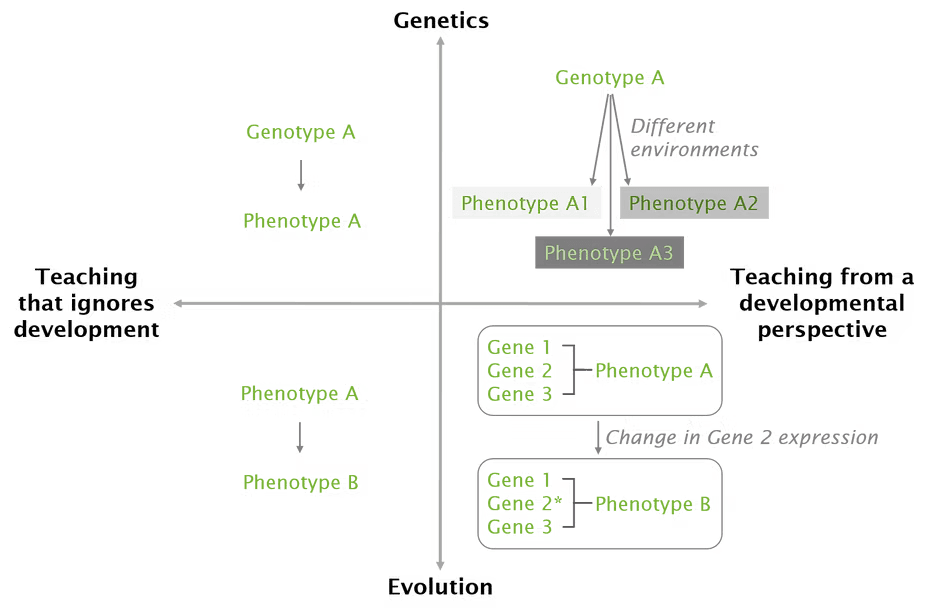
Kampourakis & Staskinakis (2018) recommend that students don’t have to learn about developmental biology per se, but a few concrete examples to show and promote an understanding of (amongst others):
- Development (the becoming that occurs during life cycles)
- Developmental robustness (the ability to develop into the adult form irrespective of the environment, such as having four limbs in humans)
- Developmental plasticity (the ability of organisms to develop phenotypic variation in adaptation to the local environment)
They suggest that the first two points should be introduced earlier than developmental plasticity. This makes sense and is in concordance with the resources of Best Evidence Science Teaching, that firstly the concept of species should be explored first.
One of the most famous examples of plasticity is the effect of the quantity of grooming that a mouse pup receives on the pup’s behaviour as an adult. Those who receive more attention show more tendency to be calm and less nervous, and also to nurture their own pups in a similar fashion.
However, some of the most fruitful discussions I’ve had have been in upper secondary when we’ve discussed Sex Chromosome Aneuploidies. Simply asking students to predict the phenotype of, say, an individual with XYY, or XXY, reveals many students who see organisms as genetically determined.
Many times they predict that the individuals will produce both reproductive systems side by side. Another productive example I’ve discussed with students is an individual who is XY but whose testicles do not descend and become deformed inside the abdomen, such that their primary sexual characteristics to not develop in a typical way.
I’m still looking for good examples to discuss with students, so if you know of any. Get in touch. Let’s see if, as Keller hopes, the nature vs nurture question can just fade away.
If this post has resonated with you, discover how to make biology meaningful for students in my book, Biology Made Real.
References
Burian, R., Kampourakis, K., 2013. Against “Genes For”: Could an Inclusive Concept of Genetic Material Effectively Replace Gene Concepts? In K. Kampourakis, ed. The Philosophy of Biology. London: Springer, pp.597-628.
Kampourakis, K., Stasinakis, P, K., 2018. Development. In K. Kampourakis & M. Reiss, ed. Teaching Biology in Schools: Global research, issues, and trends. London: Routledge, pp.99-110.
Keller, E.F., 2010. The Mirage of a Space Between Nature and Nurture. Durham: Duke University Press.
Moore, D., 2013. Current thinking about nature and nurture. In K. Kampourakis, ed. The Philosophy of Biology. London: Springer, pp.629-652.
Moore, D., Shenk, D., 2016. The heritability fallacy. Wiley interdisciplinary reviews. Cognitive science.