How excessive use of the respiration equation can cause problems
Cell respiration and its relationship to photosynthesis is one of the fundamental ideas of biology. Its ubiquitous presence in the secondary curriculum is well deserved, but do these equations cause additional problems for a more holistic understanding of life? I think so, here’s why.
The simplification I use with my students is that organic molecules play two equally important roles in living organisms:
- They provide the material for building structure.
- They provide a store of energy,
My students easily understand organic molecules as an energy source. But they struggle with the idea of organic molecules as building material.
This is where the equations of cell respiration and photosynthesis provide a problem. Simply put, they are an unwieldy simplification, especially when they are connected so that the products of photosynthesis are directly fed into cell respiration.
The simplification is useful when zooming out to see the flow of energy through ecological systems. But standing alone, and rote learnt, it hides a deeper truth.
In our age, students are used to seeing cars and other machines filled with a fuel. Their used to charging their phones, and even talking about “energy drinks”. Energy comes naturally to them.
The machines they know, however, are prebuilt. Their structures are made of metal, something completely separate from their fuel. Yet, in organisms we’re made from our fuel source.
Organisms are organised matter of organic molecules, but also derive their energy from those same molecules. It’d be like a car built from petrol, how strange.
Unlike fuel in a car, organic molecules don’t just enter a fuel deposit soon to be emptied. An organic molecule produced by a long-lived organism may persist for centuries, even millennia as part of its structure. It may also persist by forming the structure of many organisms, passed one to the other through a food chain, and then even into a decomposer food chain.
Rather than the view of a pipeline of fuel from photosynthesis to respiration, there is much to know about organic molecules in between their production and final destination.
Problems with having students memorise the cell respiration and photosynthesis equations
What’s the problem? The simplifications may produce partial, problematic, understandings. Here are two examples:
- Organic molecules function only to provide a store of energy and that organisms are made from some other substance that is not directly linked to the intake of molecules. This may take on an essentialist view point, that there is something fundamentally different about the essence of say a plant and an animal, rather than just a different organisation of the same organic molecules.
- The function of photosynthesis is to provide food for animals (tied with the misconception that animals have mitochondria and plants have chloroplasts), rather than to provide the building material for the producer itself, (and a store of energy).
If we go to its core, I find that students with these alternative conceptions have decoupled matter and energy. They can brandish around the term of energy, they may score points on assessments that require verbatim recall, but make little meaning of the substance of their own bodies or those of others.
How do organisms lose mass?
Ask a student how an adult can maintain their body mass for 20 years and you’ll probably get the answer of ‘exercise’.
Why exercise? They are resorting to folk knowledge, rather than deep understanding of the flow of matter through organisms. I find this answer in students of all ages. Despite years of biology education and knowledge of photosynthesis and respiration, students may still make little meaning how matter and life are connected beyond just providing energy.
Ask a student what happens to the body mass that is lost during a diet regime of negative energy balance and you’re unlikely to get a coherent answer.
Rather than just having students memorise and recall of chemical equations, students will require opportunities to wrestle with our nature as living organisms.
I would recommend always offering and asking for both functions of organic molecules: structure and energy. Obviously, when the focus is on energy, stick to what’s typical, but don’t let it be the only thing they learn.
Exploring the role of organic molecules as the basis of our structure may require new diagrams. My favourite is the stock and flow diagram, consider this one:
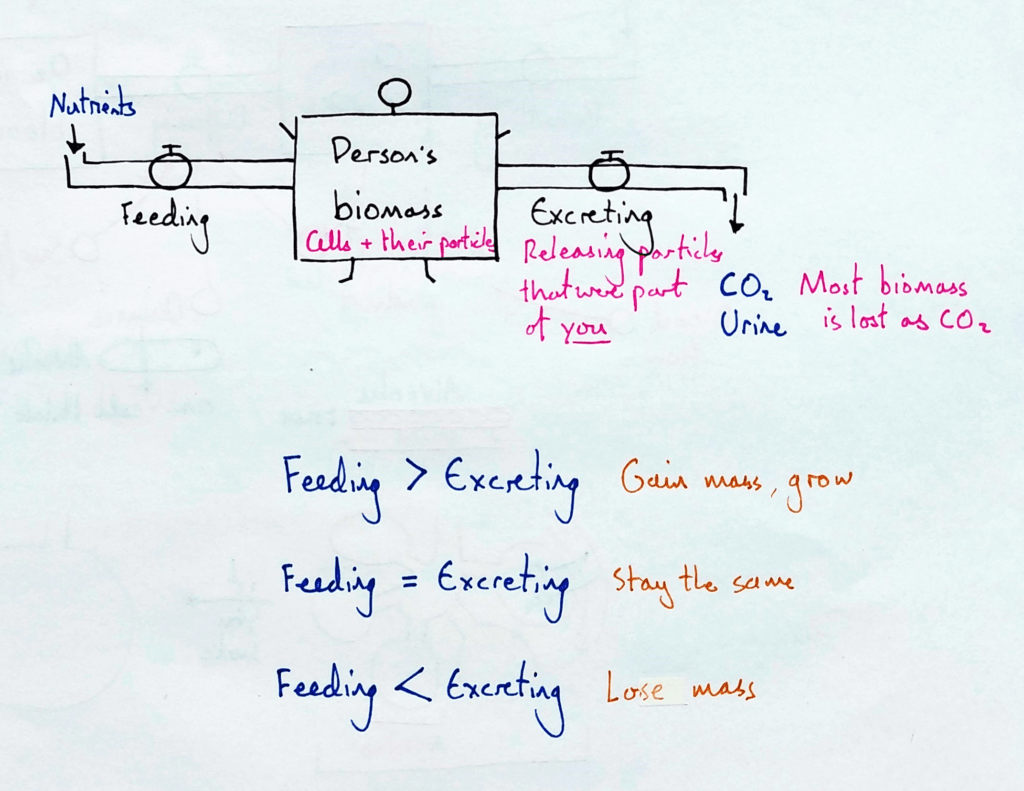
With this simple diagram, we can explore how people can gain and lose weight through exercise and diet. The key, of course, is that matter enters the body, but also leave it. These ideas then help students understand food chains as the transfer of energy and matter. We are what we eat.
If this post has resonated with you, check out my book Biology Made Real, in which I explore what makes biology meaningful for our students.