Information theory and why explaining clearly isn’t enough
Claude Shannon’s groundbreaking information theory focused on getting a message from A to B. It’s now one the major underlying theories of the computers we use every day. Its principles also tell us something fascinating about classroom communication: an explanation from teacher to student, for example, through speech or a diagram.
Here’s the model before a class begins:
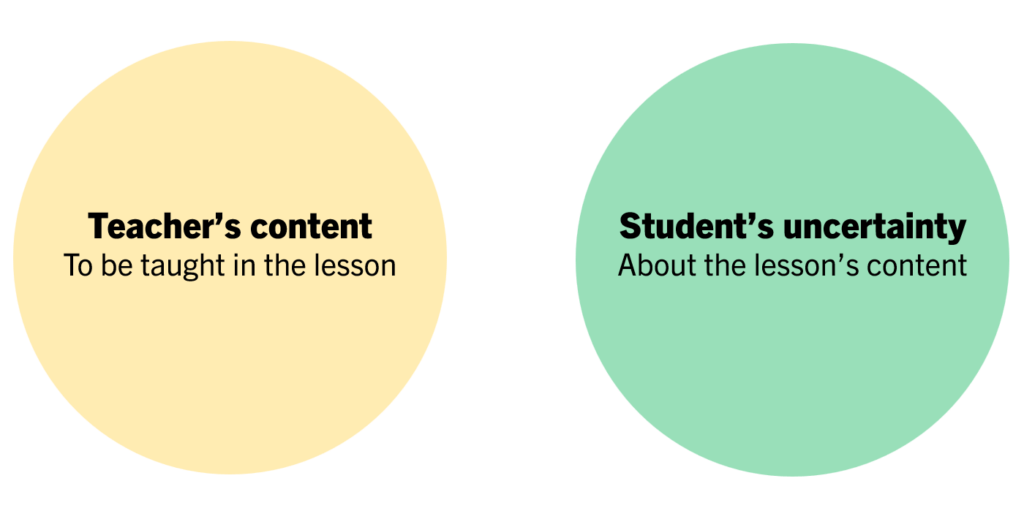
Before the lesson begins, the students (let’s assume) have no idea what they’ll be taught: there’s uncertainty. The yellow circle represents what they’ll be taught, and the green circle represents the uncertainty, their doubts, about what will be taught. At the moment, they don’t connect because the student has absolutely no idea what will be taught.
Then, the teacher starts communicating, and the lesson begins. In receiving content, the lesson solves part of the student’s uncertainty (they now know more about it). By the end of the lesson, then, how would the circles look different? Now they overlap, and the student’s uncertainty is separated into two parts: what they learned from the lesson, and the distractions they noticed. That’s shown below.
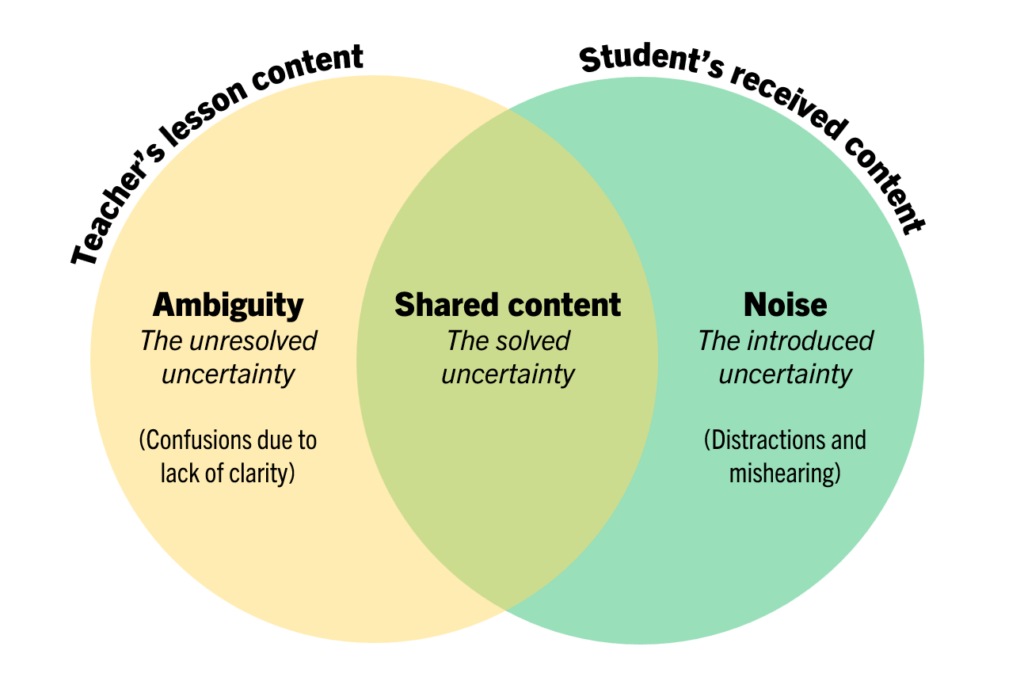
Shannon’s information was whatever solved any uncertainty. Anything that resolved your doubts had information (for you). As the students entered the classroom, they weren’t sure what they would learn; as the teacher began communicating, that changed. By the end of the lesson, the teacher and students shared at least some of the lesson’s content.
Not all the content, however, was successfully transmitted (the areas outside the overlap indicate this). Shannon identified two culprits: communication problems arise from ambiguity and noise.
Ambiguity in communication leaves people wondering if someone meant one thing or another. If we can’t distinguish which, we become “confused”. Confusion literally means to fuse two things together (which should be separate). This, then, is a problem created by teaching and amounts to unresolved learning: the students could have understood it, but the explanation wasn’t precise or explicit enough.
Noise, on the other hand, introduces new problems. Distractions add doubts. For example, a strange image next to the key text may lead us astray, or a student talking over the teacher causes us to mishear what was said.
Shared content, or the size of that overlap, could be used to judge the success of a lesson. And, therefore, as a model, it urges us to transmit content clearly (to reduce ambiguities) and avoid any distractions. Considering how successful and fundamental Shannon’s theory has been, what could go wrong?
The transmission model
Whenever we attempt to solve a problem, we think with a model (or theory). Sometimes those models are explicit, like in this post. Other times, they’re implicit, and we’re only aware of them when someone asks why they’ve thought what they’ve thought. The model we choose to think with determines the answers we come to.
As mentioned above, Shannon’s model urges us to act on two communication problems: ambiguity in our explanations and distractions. If we do so, the area of shared (successfully transmitted) content will increase. And this is sound advice, and why I prefer to teach by drawing, step by step, rather than through PowerPoint.
We could continue, however. We could follow its logic further and arrive at the idea of scripted lessons. An expert could perfectly design an explanation to lack ambiguities, which a teacher must then read aloud. We could “check for listening” and have students repeat what has been said to counteract any noise in the communication channel.
Equally, all teachers could be asked to give classroom instructions and carry out teaching techniques in the exact same way to avoid any possible confusion. These are valid when thinking with information theory.
The goal is to enlarge the “shared content” area as much as possible. Therefore, controlled lesson and topic timings can be used to avoid inefficient use of classroom time and keep the focus on transmission.
Shannon himself noted why this is wrong.
The problem of communicating meaning
Communicating clearly is an essential skill in teaching, which, again, is why I discuss the advantages of teaching without a slide deck. But Shannon’s theory didn’t include the human mind. His work was focused on the technology of the era and would be the foundation for the post-war telecommunications boom. As such, it focused on machines that transmitted signals between them, like a telegraph.
Think of Morse code, which uses dots and dashes as a code for the alphabet. Each dot and dash sent down a communication channel, like a metal cable, was just an electrical signal. The problem, Shannon noted, was that the intended meaning of the communication was not found in the signals.
The meaning couldn’t be transmitted (the teaching consequences of which I explore in Teaching Meaning). When the dots and dashes of Morse code were transmitted, the person receiving them had to form sentences and try to work out what the sender meant by those sentences.
Electrical signals were not a special case. The same happens when we write words and in speech: when we speak to our students, it’s just sound waves through the air. The students can receive the communication and recognise the words, but then they must make meaning of them. They can only do the best they can with what they know. This is, of course, why messages on social media can be so easily misinterpreted.
How can we teach if meaning can’t be transmitted?
How can we teach if the meaning of what we want to say doesn’t travel with that communication? Thanks to growing up in similar cultures and communities (including the school, classrooms, and subjects), we can often interpret the meaning based on shared experiences.
In other words, agreeing on a meaning isn’t impossible, and can be likely if two people know each other very well. It’s why we can teach better late in the school year, or even more so if we continue with the same students into the next year.
Can we, at least, transmit new content?
“What about the facts? We can transmit those.” I hear some say. What does information theory say about this? Very little, in fact. According to information theory, when a student comes to our class, they are uncertain about the lesson’s content. This sounds intuitive: how would they know stuff they’ve not yet been taught?
But the student’s uncertainty is not about learning new stuff: “What new things will I learn that I had never imagined?”. It’s actually the uncertainty about what could appear in the lesson from all the stuff the student already knows: “What will the teacher talk about today among the things we both know?”.
To see what I mean, think back to the telegraph example and Morse code. If the person receiving the message doesn’t already know that a dot and a dash means “A”, the communication is impossible and the transmission is just noise. Information theory assumes the student already shares the menu of possible ideas. It can’t explain how a student learns a completely new idea that they didn’t even know existed.
You can see the problem. The purpose of teaching is for students to learn new things and make new meanings of things they’d never even been aware of before. But in thinking with information theory, we can’t see that.
The transmission trap
I said earlier that the theory (model) we think with determines the answers we come to when solving problems. I’m still fascinated by information theory, but it’s clearly not enough. You may be thinking, “So what? I’ve never heard of anyone using information theory for their teaching”. Maybe so, but the problem extends to other theories that lean on the idea of transmission.
Cognitive load theory, for example, is currently very popular among teachers and shares the same problem. This isn’t a mere coincidence; cognitive load theory stems from classical cognitivism, whose very roots are in information theory.
Like information theory, it offers interesting models for teachers to think with. It also has little to say about how students learn new things or make new meanings. Cognitive load theory focuses on how to avoid overwhelming students; it tells us what to avoid. Like information theory, it can’t tell us how to prompt students into seeing something new.
If you only think with transmission models, this isn’t a problem on your radar, because the problem doesn’t exist in the theory. It’s why, I think, John Sweller (the founder of cognitive load theory) talks about the goal of teaching being transmission.
The question, therefore, is what works when transmission isn’t enough? That’s exactly what I explain in my book, Teaching Meaning: What Works When Telling Isn’t Enough.


References
Dupuy, J-P. 2009. On the Origins of Cognitive Science: The Mechanisation of the Mind. USA: MIT Press.
Glasersfeld, E.von. 2003. “The Constructivist View of Communication.” In An unfinished revolution, edited by Müller A. & Müller K. H, 351–360. Vienna: Edition Echoraum.
Krippendorff, K. 2009. On Communicating: Otherness, Meaning and Information. New York: Routledge.
Shannon, C. 1948. “The Mathematical Theory of Communication.” Bell Systems Technical Journal 27: 379–423 and 623–656.