The problems with Mendelian genetics in biology education
Mendelian genetics is ubiquitous in secondary school biology curricula, and the Punnet square is iconic to genetics. Think about the common examples of traits that you have seen in biology curricula to show Mendelian genetics. What could go wrong with such a solid concept?
Mendel’s work was revolutionary because it showed that the nature of inheritance was particulate, which contrasted with popular ‘blending of traits’ hypotheses of the time (like adding milk to a black tea with the result of an intermediate colour).
The iconic green-and-yellow pea colour was determined by the inheritance of a single factor (later called a gene). It’s often portrayed in the classroom; pea colours come only in green or yellow, with no blending of traits. The problem, however, is that the pea colours of the variety Mendel used did, in fact, come in many shades of green and yellow.
Mendel’s genius was to inbreed his pea plants for so long that they eventually lost all their genetic complexity. He achieved ‘true breeding’ varieties, the green and the yellow, etc. Mendel reduced the noise so that he could spot the patterns in his data. It was the stripping away of complexity that revealed that inheritance is particulate.
When Mendel’s work was ‘rediscovered’, William Bateson and Edith Saunders fiercely advocated the new Mendelian genetics. However, Raphael Weldon disagreed. He argued that the complexities of inheritance are the truth of inheritance, and that scientists should focus on these complexities (see Jaimieson & Radick, 2013).
This is the photo Weldon took to defend his position, peas of all shapes and shades:
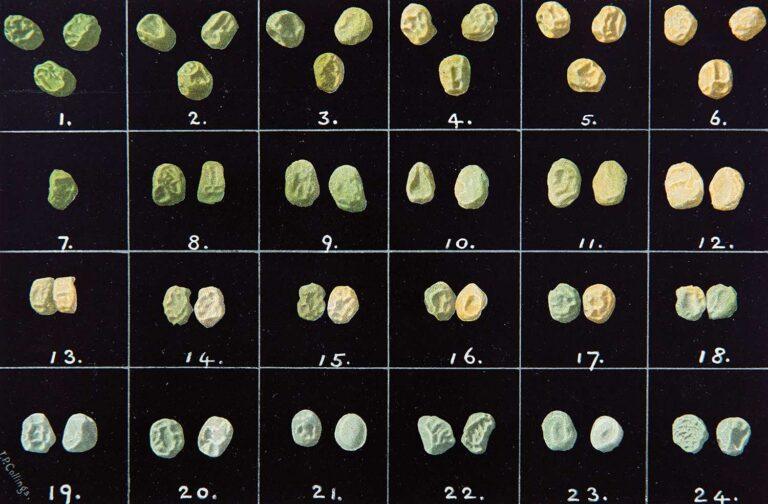
The problem was that Medelian genetics was being pushed beyond its conceptual boundaries. It no longer demonstrated the particulate nature of inheritance; it was also taken to show how genes code for organismal traits in a deterministic fashion (See Kampourakis).
As Weldon was writing a book as a counterpoint to Bateson and Saunders, he died suddenly of pneumonia, leaving the path clear for the domination of the Mendelian geneticists. But, even Bateson himself became disillusioned with Mendelian genetics by the end of his career (and was ostracised as a result) (Chaney 2019).
I see clear parallels between this piece of genetics history and many biology curricula. Mendelian genetics is portrayed not as a clever experiment that uncovered the particulate nature of inheritance, but rather how organismal traits are inherited.
This idea is dangerous. The idea that the genetic material you inherit determine who you are. Indeed, Mendelian genetics proved very popular with the eugenicists of the early 20th century, just as it is with contemporary racists (Saini, 2019).
However, we know very differently now. A genome will encode many different organismal phenotypes. The phenotype is always becoming as the organism interacts with its environment. The resulting phenotypes can’t be deduced from genotype alone.
Monogenic traits, such as lactase persistence, do exist. But these are rare; the vast majority of traits are polygenic (influenced by many genes), and interact with and are influenced by the environment.
When biology curricula continue to emphasise monogenic traits they further instil this erroneous view of genetic determinism. Many examples used in classrooms are not monogenic; for example, eye colour and hair colour are truly polygenic. This may lead to more than just confusion about phenotypes:,

This all leads to much confusion for students. At one point, students understand that genes code for traits via Mendelian genetics. Later, when learning about transcription and translation, they are taught that a gene codes for a polypeptide or RNA.
And then there is the problem of instilling the idea that genes have only two alleles in a population: one dominant and one recessive. Which is further instilled in any upper secondary course that teaches the Hardy-Weinberg principle.
Jaimieson & Radick (2017) led an experiment on university students to see if they could prevent the idea of genetic determinism from forming. They compared two curricula with two groups. One was called the Mendelian curriculum, while the other was the Weldonian curriculum. For the latter, while Mendelian genetics was used to show the mechanisms of inheritance, it was always taught alongside examples of polygenic traits and the influence of the environment on developmental plasticity.
They found that the group that received this more complex picture developed much more complex ideas about how the organismal phenotype is produced and avoided genetic determinism. The group that experienced the Mendelian curriculum, however, showed many more ideas of genetic determinism.
I think this is the model to follow for secondary biology curricula. We need much more discussion of complex examples that show the contribution of many genes and the influence of environmental interactions. Jaimieson & Radick used, for example, spina bifida, which has hundreds of contributing genes and environmental factors, such as the availability of dietary folate and socioeconomic status.
Mendel deserves his place in the curriculum, but it should explicitly be for his work on showing:
- The particulate nature of inheritance, and…
- Not how genotype relates to organismal phenotype.
I think these are good starting points:
- Discussing how Mendel inbred his plants to achieve genetic simplicity that was easier to work with but limits its power of explanation.
- Discussing the boundary limits of what can be learnt from Mendel’s work.
It may be easy to find monogenic traits for use in Punnet squares, but I still have a question: which are the best examples of showing complexity, rather than just saying that traits are affected by many genes?
Another option would be to balance this individual-level, more mechanistic, approach of how single genes are inherited with a statistical (population-level) model of trait inheritance (Reiss, 2021). Could teaching a simple model of heritability help? Not the statistics, but the probabilities of inheritance, what they mean, and some examples. I think it’s worth exploring.
References
Chaney, A. 2017. Runaway: Gregory Bateson, the double bind, and the rise of ecological consciousness. USA: University of North Carolina Press.
Jaimieson, A., Radick, G., 2013. Putting Mendel in His Place: How Curriculum
Reform in Genetics and Counterfactual History of Science Can Work Together. In K. Kampourakis, ed. The philosophy of biology. London: Springer, pp.421-454.
Jamieson, A. & Radick, G., 2017. Genetic Determinism in the Genetics Curriculum: An Exploratory Study of the Effects of Mendelian and Weldonian Emphases. Science & Education. (26). pp.1261–1290.
Reiss, M. J. 2021 How can we teach genetics for social justice? In: Genetics Education: Current Challenges and Possible Solutions Haskel-Ittah, M. & Yarden, A. (Eds), Springer, Cham, pp. 35-52. DOI: 10.1007/978-3-030-86051-6_3.
Saini, A., 2019. Superior: The return of race science. Boston: Beacon Press.