Teaching with the wrong ends of the constructivist stick
Despite the perennial debate on whether teachers should “just tell” or not, both sides of the discussion tend to accept constructivism. Constructivism is a stance on learning which broadly says that students construct meaning in their own minds.
Constructivism, however, comes in many forms; in this post, I’ll depict it as a spectrum of teaching styles. And, as the title suggests, I’ll argue that teaching influenced by either extreme is problematic.
One end influences the “transmission” style of teaching, while the other end influences the “discovery” style. Yet, the middle ground often eludes teachers; it isn’t simply an averaging of the two ends. The middle ground isn’t about mixing a bit of explicit teaching with a bit of exploratory activities. Instead, it’s an entirely different stance and style of teaching.
Despite the apparent gulf between the two, transmission and discovery styles mirror each other.
The difference between transmission and discovery stances
The major difference between these stances can be summarised by juxtaposing two views (Foerster et al. 2014):
- “Say it how it is”.
- “It is how you say it”.
Say it how it is
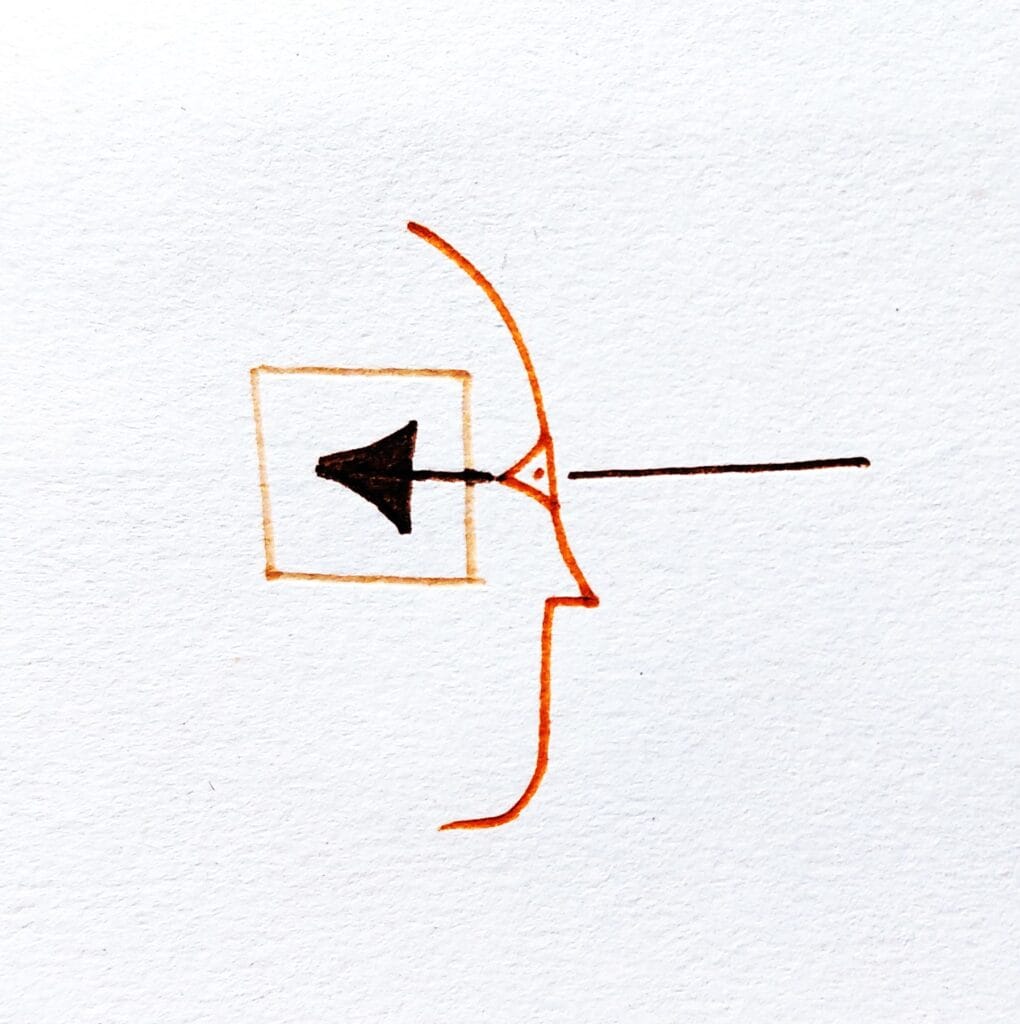
When we “say it how it is”, we assume we have the information and merely reproduce and relay it (Figure 1). Information, content, and concepts exist “out there” in the environment, and the mind endeavours to obtain ever more correct versions of it.
In other words, the world is the cause, and our experience is the consequence. Students, therefore, must be shown the world as it is. This is the view that leads to pedagogies of content delivery and repetition.
It is how you say it
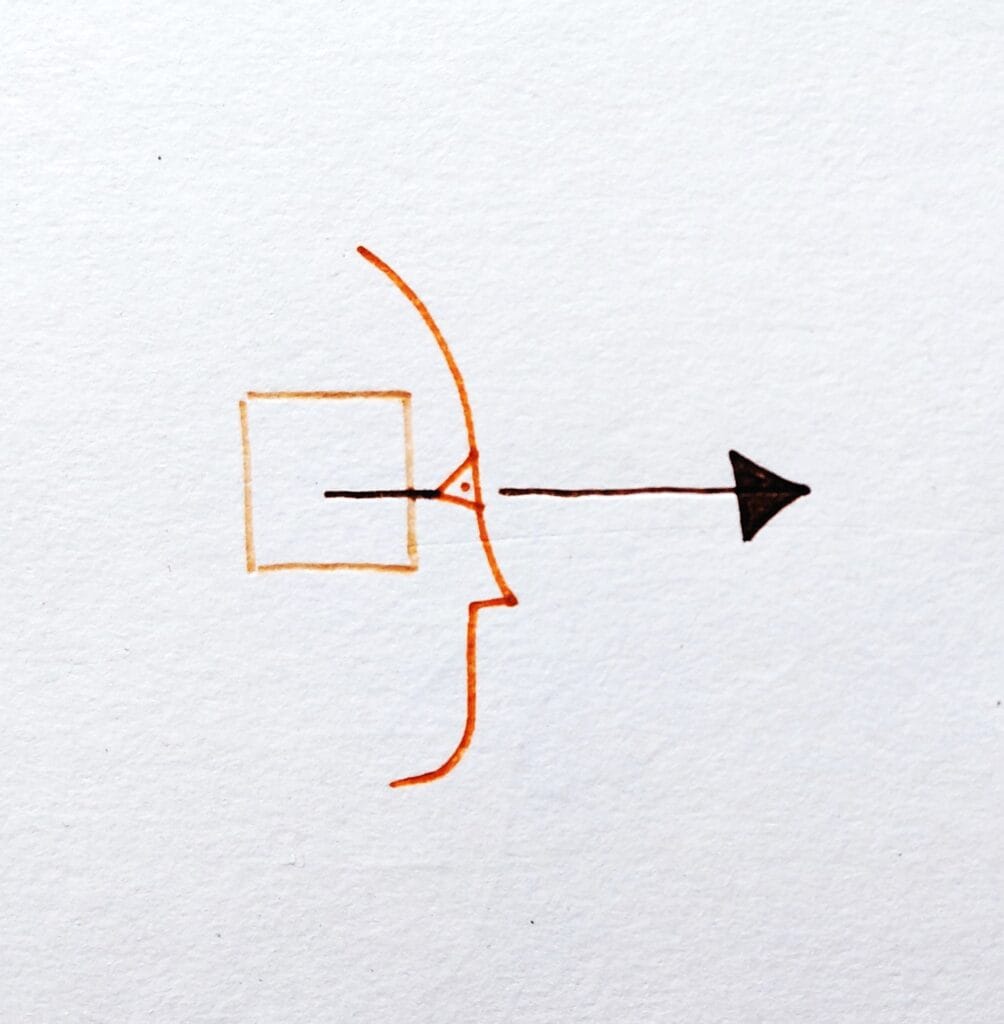
When “it is how you say it”, the reverse is assumed (Figure 2). Information doesn’t exist “out there”; instead, we construct a version unique to us. Therefore, the way we speak about the world, we bring forth a world.
Obviously, we can’t create objects just with our thoughts. There is a useful distinction between the facts we all agree on and the meanings we make of them1. The best example is the various ways that journalists will cover the same story. Each, supposedly, has access to the same facts, but the overall picture they paint can be wildly different.
Due to the limitations of our bodies, we can’t sense reality as it really is. And so, all we can do is construct ideas, concepts, and meanings in our minds. In other words, what we experience is the cause, and the world the consequence. Students, therefore, must experience.
This view can lead to pedagogies of discovery activities that students explore with little guidance.
The similarity between transmission and discovery stances
The discovery stance prioritises the construction of knowledge. The focus, therefore, is on providing activities that ensure students experience what should be constructed.
The transmission stance may accept the idea that students construct ideas. But often sees it as a constant process of the mind; something that happens regardless of the teacher. The focus, therefore, is on what a teacher can control: the content. How it can be precisely sequenced, exemplified, and explained, while avoiding ambiguities and noise.
Here, the difference is highlighted again. In one, the teacher organises the content. In the other, the student organises the content. But lurking below this difference is a key similarity. In both, content is foregrounded, and the teacher is backgrounded.
This isn’t to say that the teachers aren’t active participants in a lesson; there may be intensive discussions during explicit teaching or exploratory hands-on activities. It’s to say that the teacher is separated from the content itself.
As an example, Engelmann, the creator of Direct Instruction, states that “concepts are not the property of the mind” and that when students fail, they fail to be “perfect mirrors” of the environment.2
In other words, the teacher plays an important role in creating the necessary conditions for learning. They modify the efficiency of learning, but could be removed from the process. Students aren’t learning the teacher; they are learning or constructing the content of the world.
If these are the two ends of the constructivist stick, what’s it like in the middle?
The middle position
As debates flourish, some contend that teaching should occupy a middle position between these stances. Unfortunately, what they often refer to is not a middle position, but a mixed approach: some “telling” and some “exploring”. In this way, they see the middle position as an average of two extremes. Over time, students’ knowledge will be a result of both, on average.
The middle position isn’t alternating between two ends of the stick. It’s a legitimate stance in itself, bolstered by the sciences of mind: enactive cognitive science and second-order cybernetics. In this view, students don’t just learn content; they also learn their teacher.
Everything said is said by someone
Humberto Maturana’s deep truth, everything said is said by someone (1987), brings the teacher back into the foreground. Whenever we read a text, it has been written by someone. Whenever we hear an explanation, it has been said by someone. Whenever we browse a diagram, it has been developed by someone.
Whether it be a human or a machine, content doesn’t exist by itself “out there”. The content is always expressed in a language or form that is particular to someone and their history of sensemaking.
Accordingly, two teachers could teach the same content but provoke different outcomes from their students despite the same standardised curriculum. One, for example, may have spent much of their career in industry and another in academia. Each will approach that content and talk about it in ways deeply influenced by their lived experiences and resulting perceptions.
In biology, some teachers approach the content from a molecular perspective: genes and molecules are what matter, and they shed light on the rest. Other teachers, including myself, approach the very same content from an organismal perspective: the whole organism is what matters and makes sense of the rest.
Likewise, due to my reading and interests, I do biology through co-developing causal stock and flow models with my students. But most other teachers differ in how they act with biology. When our students graduate, they take with them different ways of doing biology; distinct ways of acting with the subject.
In other words, I’m not just a vessel of biological facts who can choose correct examples or good activities. I’m an expression of biological knowledge in the way I act with biology.
Incidentally, the word “fact” stems from the Latin for “to do” and “done” and is related to the word “feat“. My students, therefore, are learning how to do biology: how to act with biological knowledge. And it’s this aspect of learning that foregrounds the teacher who models how to enact a subject.
Everything said is said to someone
Maturana’s first principle, that everything said is said by someone, was later complemented by his good friend Heinz von Foerster: everything said is said to someone (Foerster 2002, 283). He was worried that Maturana’s deep truth could prompt, erroneously, the kind of thinking I’ve described about discovery teaching.
“The decisive point”, he said, “is always the being-together.” (Foerster et al. 2014, 158).
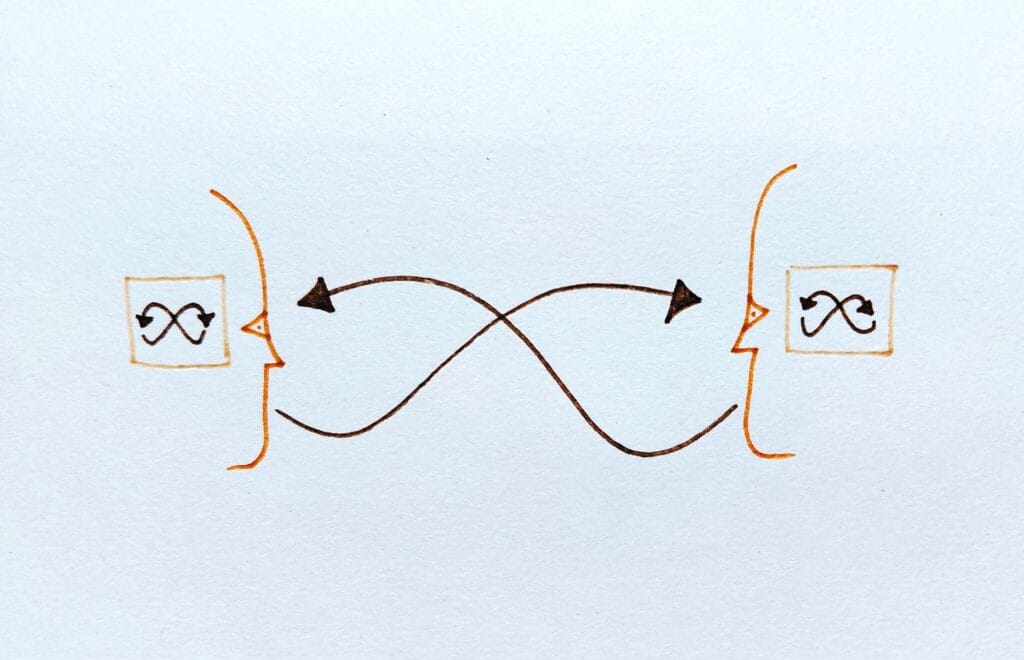
Both von Foerster and Maturana were pioneers of contemporary enactive cognitive science. And with their two principles, the loop between teachers and students begins to close. It’s not a case of a teacher gathering prepackaged concepts and simply transmitting them, nor a student independently constructing concepts in their minds. Instead, it’s an acting-together in which both must adapt to the other’s moves (Figure 3).
In classrooms, students adapt to their teacher
In Figure 3, rather than facts entering the mind from the environment (Figure 1), or the environment being constructed from the mind (Figure 2), the teacher’s and student’s minds focus on the interaction.
Teachers must express knowledge in speaking, drawing, writing, gesturing, and performing. Students must make sense of these acts and respond in turn through their own actions. Now it’s the teacher’s turn to make their move: they make sense of their students’ actions and respond.
The students, at every moment, are attending not to independent facts of the world, but their teacher’s choices and expressions. To get it right in a lesson is to act adequately according to the disciplinary standards modelled by the teacher. When tasks are given or questions posed, students will seek approval from their teacher and then adapt to their teacher’s response.
The middle point on the constructivist stick is unique for a simple reason3. At the extremes, only one side of the interaction matters:
- At one end, the world matters and students must conform by obtaining its information (neatly packaged by teachers).
- At the other end, students matter, and the world must conform to their constructions (prompted by a teacher’s choice of activities).
- At the middle point, as students learn through interaction, both matter and both must conform. We learn from the world by acting and seeing how it responds (including a teacher’s response), but in doing so we also change it through the moves and utterances we make.
Teaching, in this sense, is a conversation; a back-and-forth interaction. In conversations, we take turns making moves to arrive at a mutual understanding. We rephrase previous utterances as students ask us questions. We refer to what we’re saying and to previous conversations in such a way that conversations continually build on each other (Maturana 2011). We continually adapt to the other’s sensemaking until it appears we understand each other.
Students learn their teachers (and their communities)
Teachers, of course, aren’t isolated expressions of knowledge. And some teachers reading this will be asking about objectivity and disciplinary standards; what about maths and science and facts?
These standards and protocols come from the communities we’ve participated in. My community, whether at university or online, has consisted of biologists. Together, our conversations align our ways of talking about and doing biology. Even mathematicians have communities that deliberate what matters (to them).
In fact, schools often defer these conversations to groups of experts known as an exam board. This community classifies actions into grades according to the knowledge they represent. Objectivity here is really a community’s way of regulating and aligning its conversations through shared standards and protocols for judging action4. In other words, students also learn their teacher’s communities.
Nevertheless, despite the endeavour to align our practice, even within subjects and across year groups, students must learn their particular teacher. For example, primary school students, after a year of adapting to their teacher’s way of being and doing, often struggle to begin again with a new teacher.
In my case, I do biology with stock-and-flow modelling and mechanistic reasoning, something not very common currently. When students arrive in my classroom, routines that were successful in previous classrooms may no longer be so, despite studying the same subject.
As students graduate from our schools, they don’t do so as walking banks of knowledge. They do so, instead, as expressions of knowledge in how they act and converse. The success of our students depends on the future communities they can participate in, whether they be university departments, hobbyist groups, or hospital wards.
In turn, being able to participate in communities depends not on having knowledge but on adequately acting with it. Therefore, the adage shows its worth: “It takes a village to raise a child”. The teacher isn’t a disposable element of learning; their varied ways of acting with knowledge are an essential component of a child’s education.
Teaching moves for the middle point of the stick
In Teaching Meaning, I propose five essential teaching moves that emerge from the middle way: Communicating, Conversing, Varying, Modelling, and Practising. Whichever move we make in the classroom, we’re always teaching ourselves: our way of seeing and approaching the content. Yet, one move explicitly shares what matters to us: modelling.
Modelling enacts and embodies ways of understanding. As everything said is said by someone, there are no meanings “out there” to be found. We must embody, personify and exemplify the meanings of what we teach.
Thinking aloud, for example, must be the most versatile and practical form of modelling. Notice how it works in this example:
To support students, a teacher may project one of their questions and provide an example answer (the content). Another teacher may do the same, but instead of just writing the answer (the content), they also speak their thoughts aloud: what they notice, what matters to them, and what decision they’d make (how they perceive the content).
Thinking aloud can be performed by anyone in any context. It also doesn’t have to be about academic content. In primary school settings, for example, teachers instinctively model social expectations or curiosity.
If grabbing the middle point of the stick has interested you, discover its meaning and teaching moves in my book Teaching Meaning: What Works When Telling Isn’t Enough.
References
Di Paolo, E., Cuffari, E., and De Jaegher. 2018. Linguistic Bodies: The Continuity Between Life and Language. USA: MIT Press.
Engelmann, S., and Carnine, D. 1991. Theory of Instruction: Principles and Applications.
USA: NIFDI Press.
Engelmann, S., and Carnine, D. 2011. Could John Stuart Mill Have Saved Our Schools? USA: Attainment Company.
Foerster, H.von. 2003. Understanding Understanding: Essays on Cybernetics and
Cognition. USA: Springer-Verlag.
Foerster, H.von, Müller, A., and Müller K. 2014. The Beginning of Heaven and Earth
Has No Name: Seven Days with Second-Order Cybernetics. Translated by: E Rooks
and M Kasenbacher. Ebook Edition: Fordham University Press.
Foerster, H.von, and Poerksen, B. 2002. Understanding Systems: Conversations on Epistemology and Ethics. New York: Kluwer Academic/Plenum Publishers.
Glasersfeld, E.von. 1995. Radical Constructivism: A Way of Knowing and Learning. London: Routledge Falmer.
Maturana, H. 1987. “Everything Is Said By An Observer.” In Gaia, A Way of Knowing: Political Implications of the New Biology, edited by William I. Thompson, 67–84. USA: Lindisfarne Press.
Maturana, H., and Poerksen, B. 2011. From Being to Doing: The Origins of the Biology of Cognition. 2nd Edition. Ebook Edition: Carl-Auer Verlag, 2004.
Maturana, H., and Varela, F. 1992. The Tree of Knowledge: The Biological Roots of Human Understanding, revised edition. USA: Shambhala Publications.
Maturana, H., and Verden-Zöller, G. 2008. The Origin of Humanness in the Biology of
Love. Ebook Edition: Imprint Academic.
Pickering, A. 2025. Acting with the World: Agency in the Anthropocene. USA: Duke University Press Books.
Poerksen, B. 2004. The Certainty of Uncertainty: Dialogues Introducing Constructivism
(A. R. Koeck and W. K. Koeck, Trans.). Ebook Edition: Imprint Academic.
Watzlawick, P., and Poerksen, B. 2004. “Reality: We Can Only Know What It Is Not.” In The Certainty of Uncertainty: Dialogues Introducing Constructivism, edited by B. Poerksen (A. R. Koeck and W. K. Koeck, Trans.). Ebook Edition: Imprint Academic.
Varela, F., and Poerksen, B. 2004. “Truth Is What Works.” In The Certainty of Uncertainty: Dialogues Introducing Constructivism, edited by B. Poerksen (A. R. Koeck and W. K. Koeck, Trans.). Ebook Edition: Imprint Academic.
- Watzlawick and Poerksen, Reality: We Can Only Know What It Is Not. ↩︎
- It doesn’t seem likely to me that Engelmann would accept most constructivist claims after reading his own ideas. However, he branched beyond behaviourism and did consider generalisation to be an important cognitive process. Maybe, he would accept trivial constructivism: the idea that the mind must construct towards correct representations of information in the environment. Nevertheless, I include him here because many teachers who embrace his ideas also appear to embrace Ausubel’s cognitive constructivism. ↩︎
- Varela and Poerksen, Truth Is What Works. ↩︎
- Di Paolo, F/acts: Ways of Enactive Worldmaking. ↩︎