Models (14–16): Urinary system
Water homeostasis
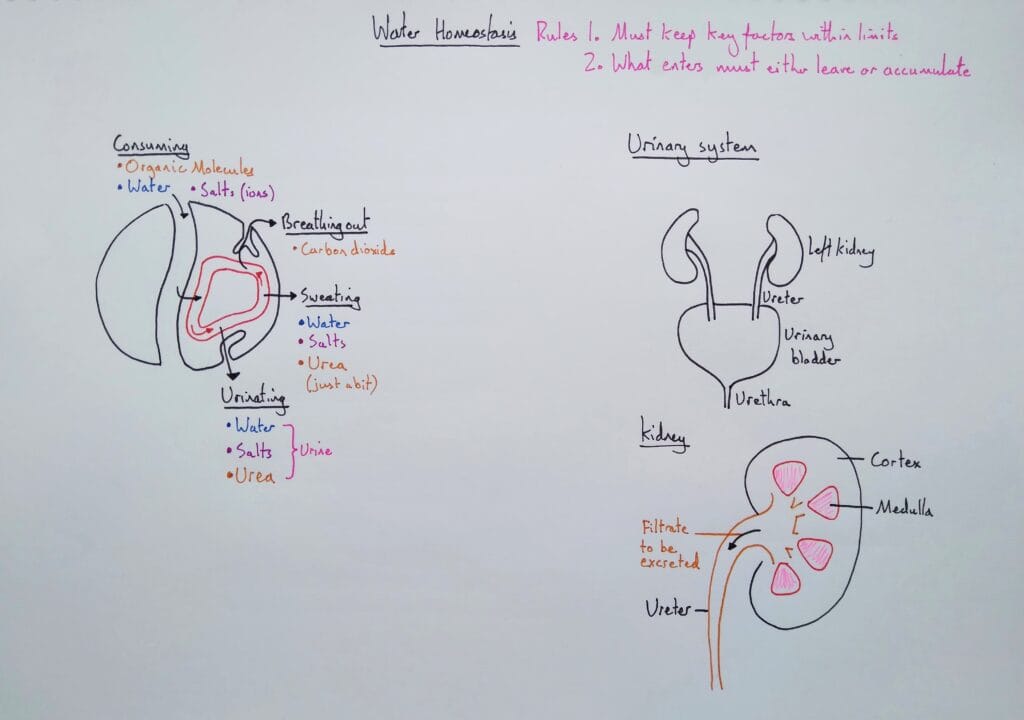
This lesson begins the topic by considering the whole organism and its needs. It relies on two rules of biology: 1. Homeostasis: stable systems must keep key variables within limits, and 2. Mass Balance: what enters a system must either leave it or accumulate within it. These are two rules of biology I refer to constantly; in this lesson, students practise applying them once more. See Teaching Meaning to read more about teaching with “rules”. We also look at the general structure of the urinary system, giving it a place before studying its parts.
Nephron structure and function
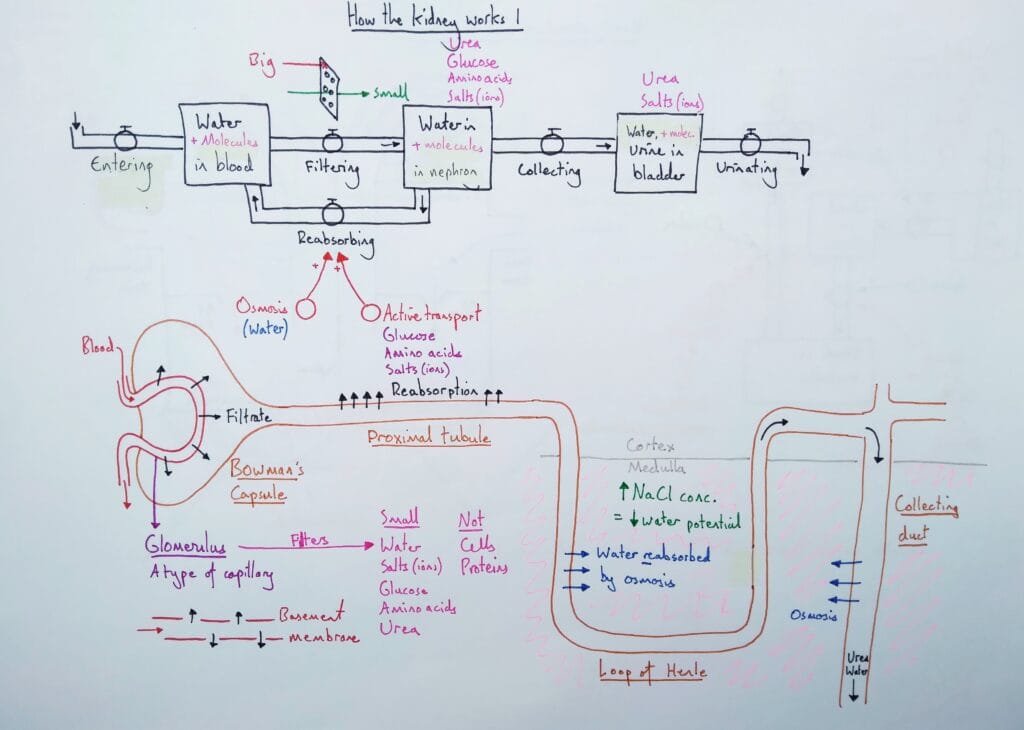
I really enjoy teaching this system due to its dynamic nature. It lends itself well to a stock and flow model, which invites much discussion. Read how I explain a version of this model (for 16–18) in this post.
ADH and osmoregulation

This concept is often taught as a linear mechanism, and indeed, it’s often what students need to learn for their exams. However, it’s very clearly a circular mechanism; a negative feedback loop. The stock and flow model shines by allowing the co-construction (with students) of the feedback mechanism. Students must decide whether the connections are + or –, and then whether the feedback loop is positive or negative. Then, we can extract two linear mechanisms from the stock and flow model: one for low and another for high water potential.
Learn how to teach with just diagrams and dialogue in my books: