Models (14–16): The Nature of the Organism
The central thesis of my book, Biology Made Real, is that meaning in biology arises from understanding the whole organism and its way of being. Most biology courses begin by diving into the details of cells and molecules, but with little reference to their meaning for an organism’s life. In contrast, I begin my courses with the general idea of autopoiesis, the self-producing nature of organisms, which determines how they must act to maintain themselves. As we go through the course, we will dive deeper into physiological mechanisms, but their meaning will always be in the light of the whole organism’s way of being.
Stem cells: the self-producing nature or organisms
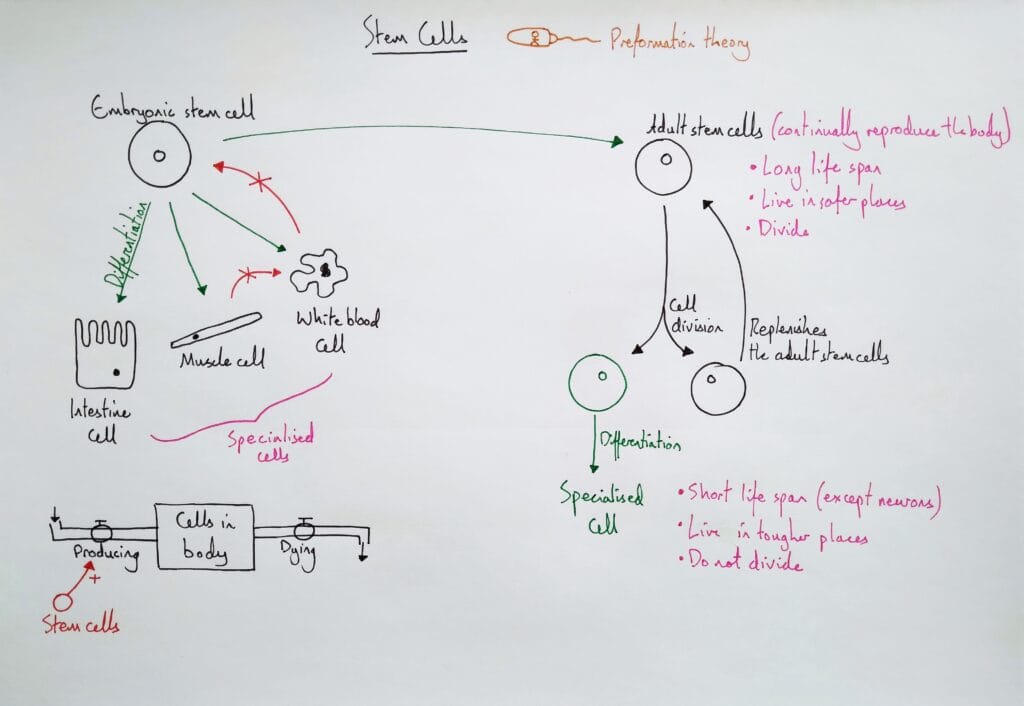
Stem cells are often taught in the context of therapy, a missed opportunity. Stem cells are the units of self-reproduction; they replace our constantly dying cells. Thanks to the second law of thermodynamics, we’re in a constant process of breaking down, but we match this with a constant process of self-renewal, our autopoiesis. Starting here, therefore, sets the frame for the rest of biology: organisms must strive to maintain their autopoiesis. While students generally understand that they require a constant flow of energy, they must also understand that we need a constant flow of matter to maintain our structure. There is a stock and flow model to summarise the idea. Remember, you can learn to teach with these in my book, Difference Maker. See how I introduce them here.
Organic molecules
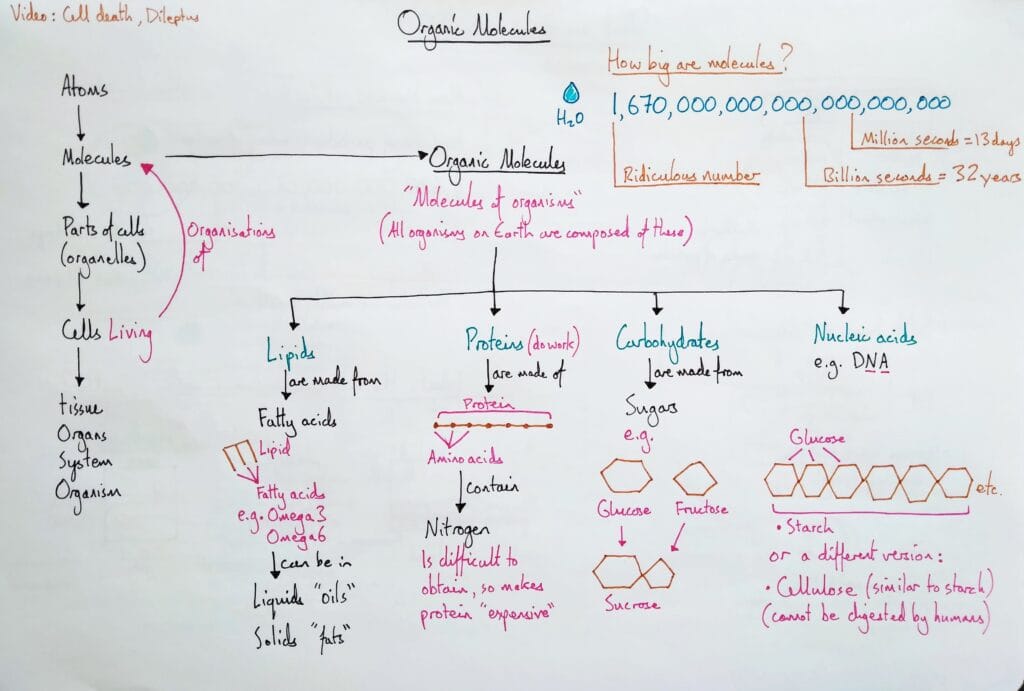
This lesson, as simple as it seems, typically takes me two lessons. I spend the first lesson just discussing the meaning of organic molecules to an organism. Despite being 14-years-old many of my students still aren’t sure, for example, which is bigger: a molecule or a cell. Or, in fact, which of the two is alive. Then comes the next big question: if molecules aren’t alive, how can a cell be alive if it is made of nonliving molecules? We watch videos of cells dying (here, and here), and I ask students what changed. The model, at this stage, is that death results from a loss of organisation. If molecules are organised in particular ways, they can produce a whole that self-produces (autopoiesis). As long as that is, there is a membrane that can keep them all together.
In the next lesson, we can explore what organisms are made from. But here lurks more confusions that need addressing. They assume, as we’re studying it, that we must be made from these organic molecules. But what about plants, fungi, or even fish? Having students vote on these choices reveals the confusion. I then ask them, for example, where a vegan gets the molecules they need to build their own structure. From plants of course, so they must be made from the same types of molecules. In the end, we’re all family members who can trace our ancestry back to the same population. Discussing these things makes biology real.
Balanced diet
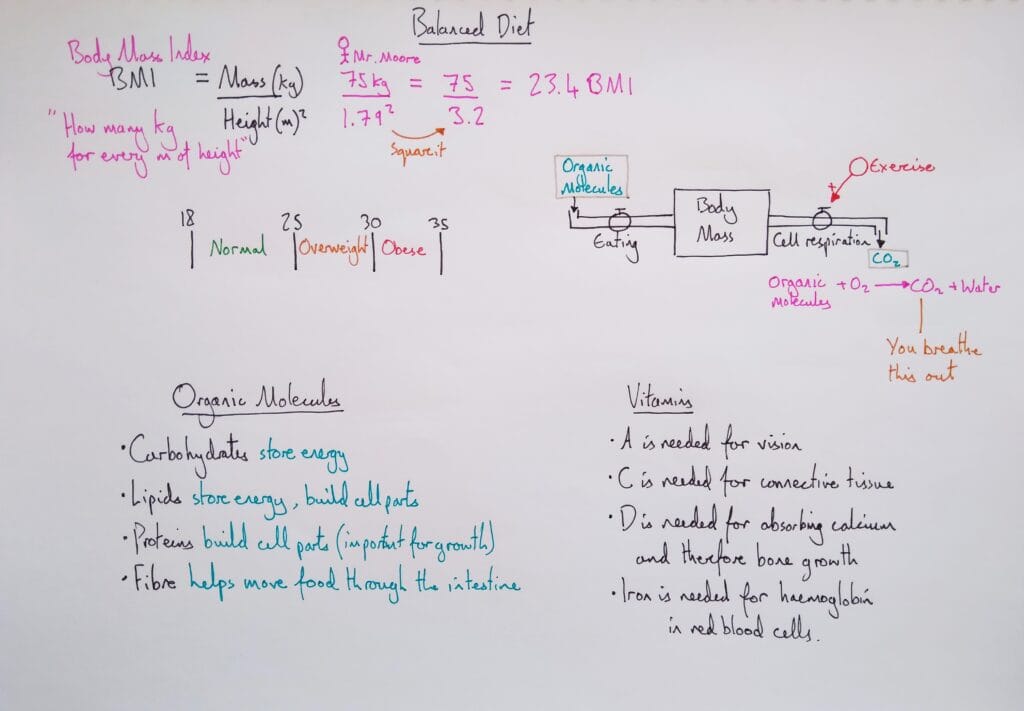
If we’re made from organic molecules and require a constant input of them into our bodies, can we consume too much or too little? This is folk knowledge for students; they know that they can gain mass through eating more, and lose mass through dieting. Yet, ask them how that mass is lost, and they have no idea. They have no idea that the majority is lost through carbon dioxide that we simply breathe out. In general, students find inputs to systems intuitive but struggle more with outputs. This is where stock and flow models shine (learn how to teach with them in Difference Maker). How do we gain mass, then? The consumption must be higher than the excretion. So what about an adult who has maintained their mass for decades yet continually consumes organic molecules? The consumption must match the excretion. I extend this idea in the next lesson.
The animal as a flow of energy and matter
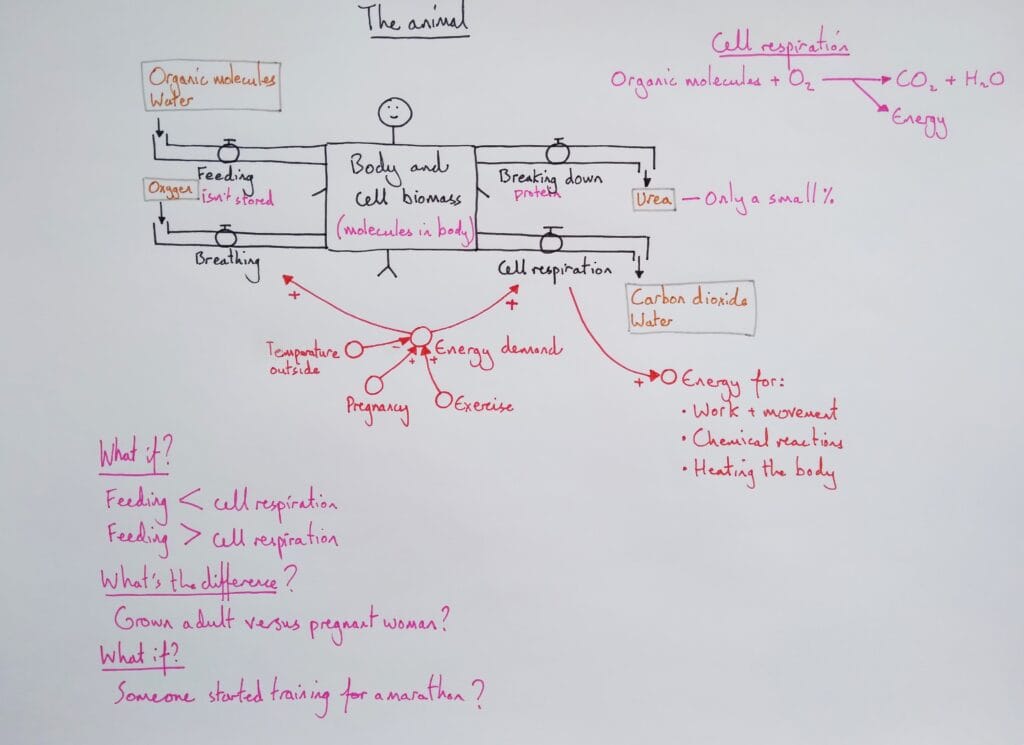
In my experience, these are the deep meanings that students need to make sense of to truly understand biology. But it won’t happen in a lesson; it’s not content they can memorise, repeat, and be done with. It must become a way of seeing and talking about organisms. And, so, in this lesson, I continue to discuss the human as an autopoietic being that balances consumption and excretion. The model introduces urea as another substance of excretion and factors that would affect energy demand, and, therefore, the excretion of carbon dioxide. Learn how to teach with stock and flow models in my book Difference Maker.
Cell respiration: aerobic and anaerobic
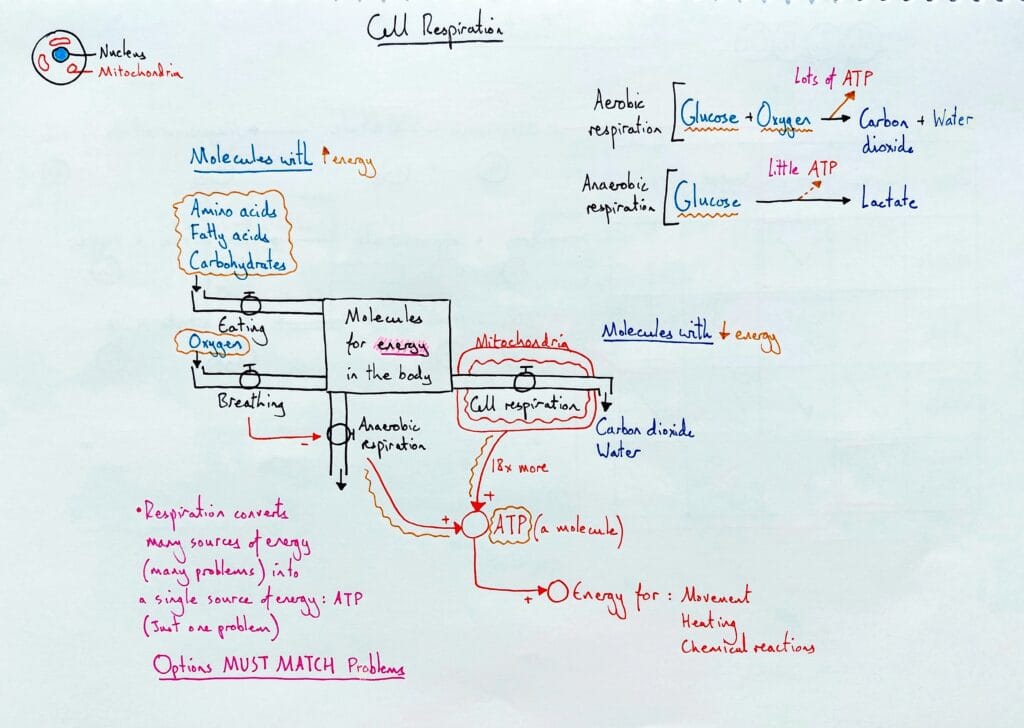
My students will have been talking about cell respiration since their first secondary school biology lessons (11–12). Now, it’s time to make finer distinctions. Notice how this model is similar to the model from the previous lesson. I’ve simplified it by removing the excretion of urea, and made the extra distinction between aerobic and anaerobic respiration. They are distinguished by their reactants and products, but the meaning comes from distinguishing the quantity of ATP produced. And, therefore, the meaning comes from how each mode of respiration affects the organism’s ability to live its life. Lest ATP become “just another molecule”, it’s discussed in terms of reducing the number of problems the cell must adapt to. From many possible sources of energy, respiration reduces them all to one: ATP.
Thermoregulation
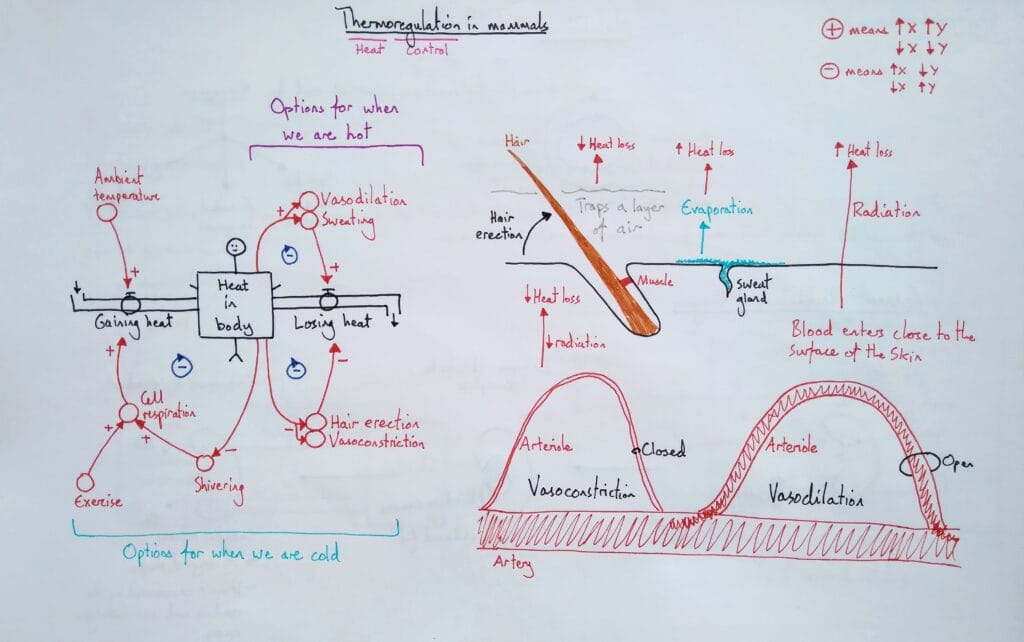
I explain this model here.
As I explain in Biology Made Real, most students think organisms (including themselves) are machine-like. This brings many problems. Machines aren’t autopoietic (they don’t self-produce). Importantly, machines, like cars, don’t adapt to maintain themselves. If you remove a part, they do nothing about it. This lesson, then, is one in which I emphasise our necessary adaptive ability: we must continually adapt to maintain our autopoiesis. It typically takes me two lessons to build this model, as the stock and flow model reveals many interesting confusions. When I ask, for example, what causes shivering, students think it’s caused by the ambient temperature (rather than the internal body temperature).
Learn about teaching this way, without powerpoint or worksheets, in my books: