Models (14–16): Human gas exchange
Diffusion in alveoli 1
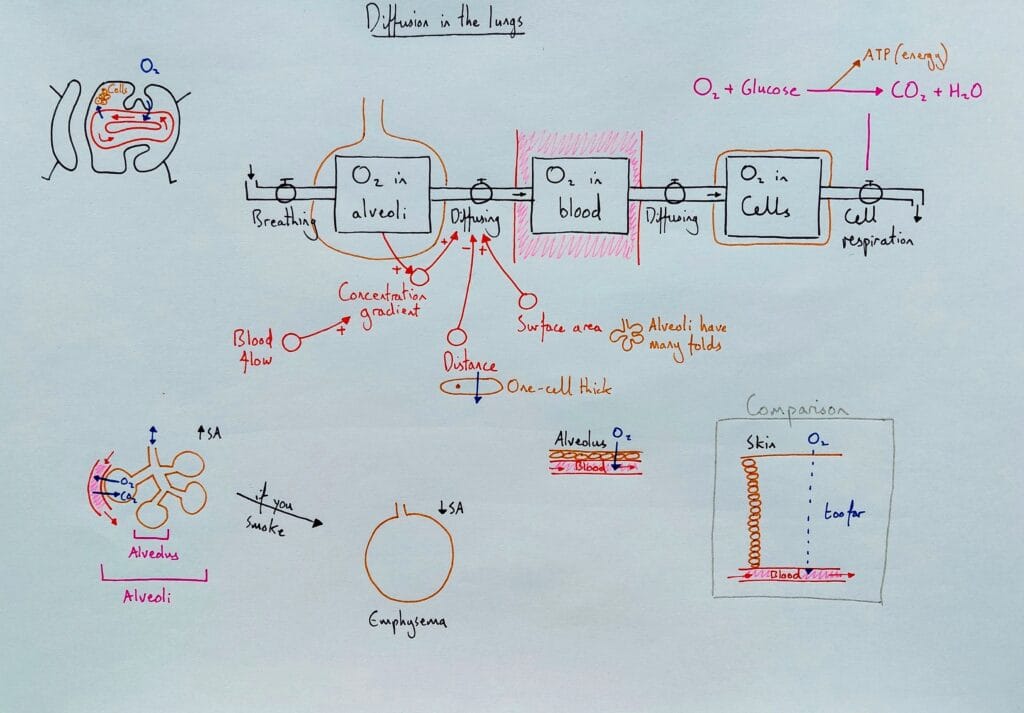
This less introduces gas exchange, so it requires contextualisation: how does gas exchange fit into the whole system? It requires images of the respiratory system, then of the alveoli. And, a model for the function of all these things. The function is whatever maintains the organism’s autopoiesis. I build the stock and flow diagram with students (see how to teach with these in Difference Maker). Adding the pictures around the diagram really helps students. Then I move to discuss the variables that enable diffusion at the alveoli. As I explain in Biology Made Real, contrasting the structure with other systems is the best way to perceive the meaning of the biology. In this lesson, I contrast the alveoli with the skin; both act as exterior surfaces of our bodies, but only one has evolved for exchange.
Alveoli and diffusion 2
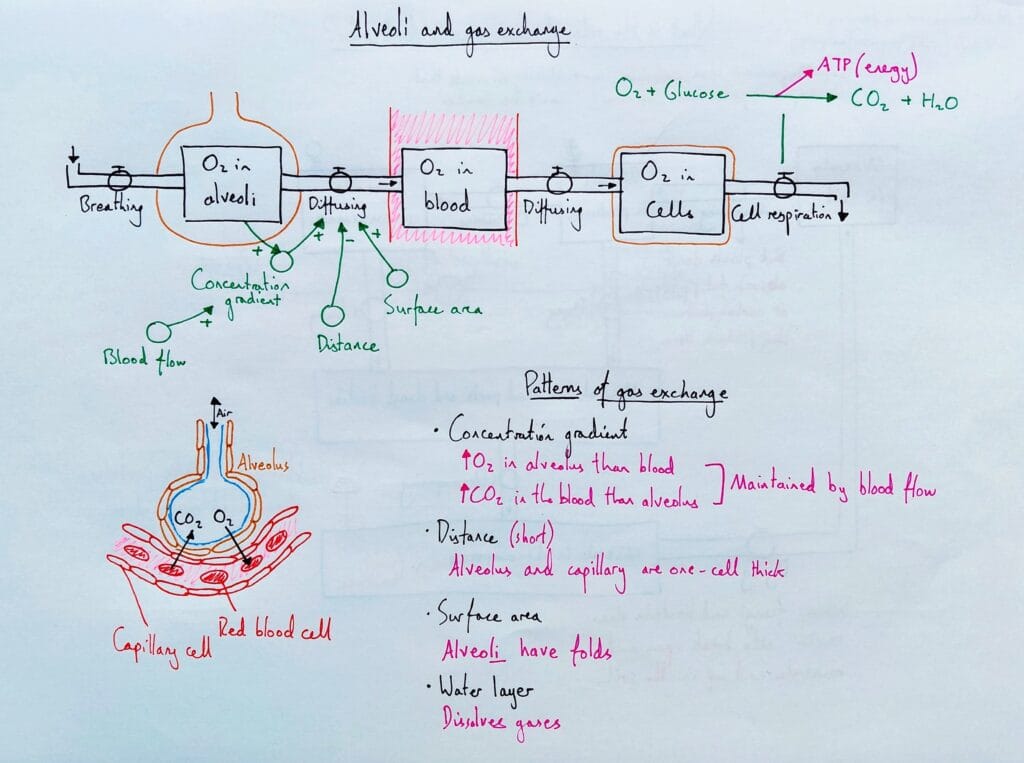
While the previous lesson included alveoli structure, it focused more on the function within the system. As I argued in my first-ever paper, parts of biological systems become more concrete when they form part of a set of relations. So, the first lesson put alevoli within a mechanism for delivering oxygen to cells. In this lesson, I focus more explicitly on the structure itself. I begin by drawing the stock and flow structure and asking students to fill in the details from memory. Then we draw the alveolus and explore the meaning of the structure by asking, “What if this part were different?”. Learn how to teach with these questions in Difference Maker and Teaching Meaning.
Lung ventilation
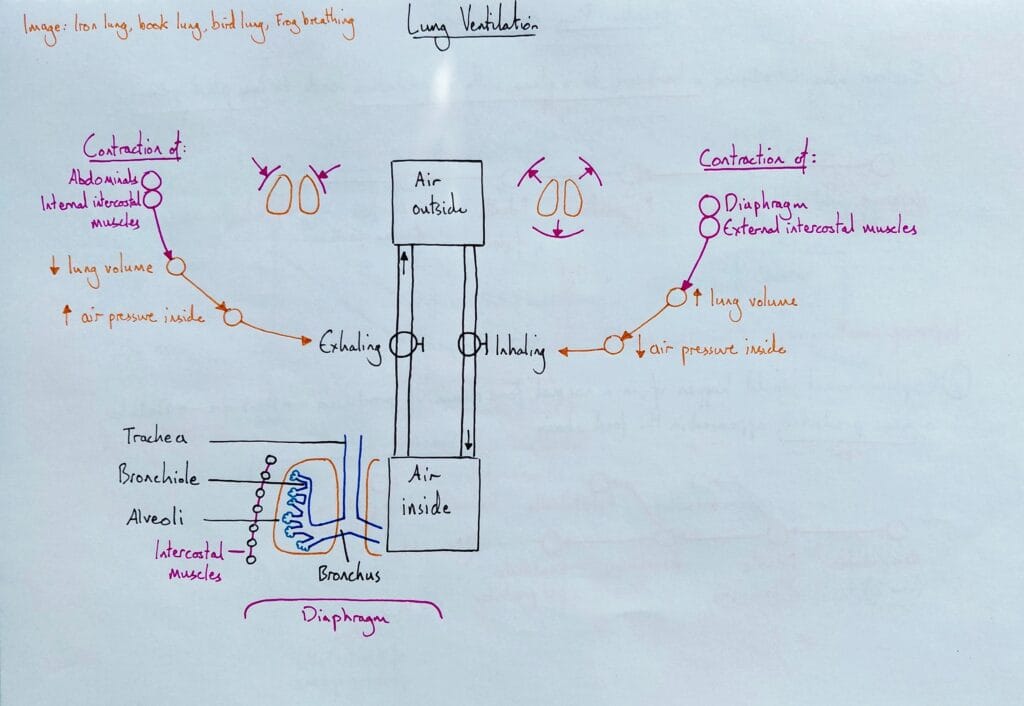
In typical biology curricula, ventilation is taught as a linear mechanism. This stock and flow model captures this, but there’s a catch. Normally, I use the symbols + and – for causal relationships (see how I introduce stock and flow models here).
- + is like a positive correlation: ↑X → ↑Y, or ↓X → ↓Y. Students find these quite intuitive.
- Things get trickier with negative correlations: ↑X → ↓Y, or ↓X → ↑Y.
I’ve found that students can get confused when following linear mechanisms that have lots of negative relations. This model epitomises the problem. Therefore, as an exception to the method, here I decided to teach the mechanism using arrows: ↑ lung volume → ↓ air pressure inside → ↑ inhaling. People may ask why I don’t do this always: a great question! The reason? When you use arrows, you only get one explanation, and the model becomes hard to explore using “What if?” questions. The mechanism, therefore, becomes something to memorise. When using + and –, you can ask “What if?” and follow how the system would change: you can get many explanations, many views of the system. As I explain in my books, Difference Maker and Teaching Meaning, variety (like a variety of views that show how things could be different) is the absolute key to making meaning.
Discover how to teach this way in my books: