Models (14–16): Diffusion
Diffusion is a core concept in biology; it’s never far away. That’s because it poses important constraints in the form (shape) of organisms and their behaviour. As I argue in Biology Made Real, it’s this relationship, how it affects the life of the whole organism, where students find meaning. Diffusion will come up again in later topics: exchange in lungs, leaves, placenta, and the intestine. But before we get to generalise the idea across these examples, I want students to understand the tight relationship between diffusion and life.
Many students attempt to memorise patterns of exchange surfaces: High surface area, low distance, concentration gradient. Through this approach, they can’t understand the causes of diffusion. And this means that they might pick up some marks on an exam for stating the patterns, but struggle to think with the idea to make inferences. Therefore, I dedicate time to each pattern.
Concentration gradients
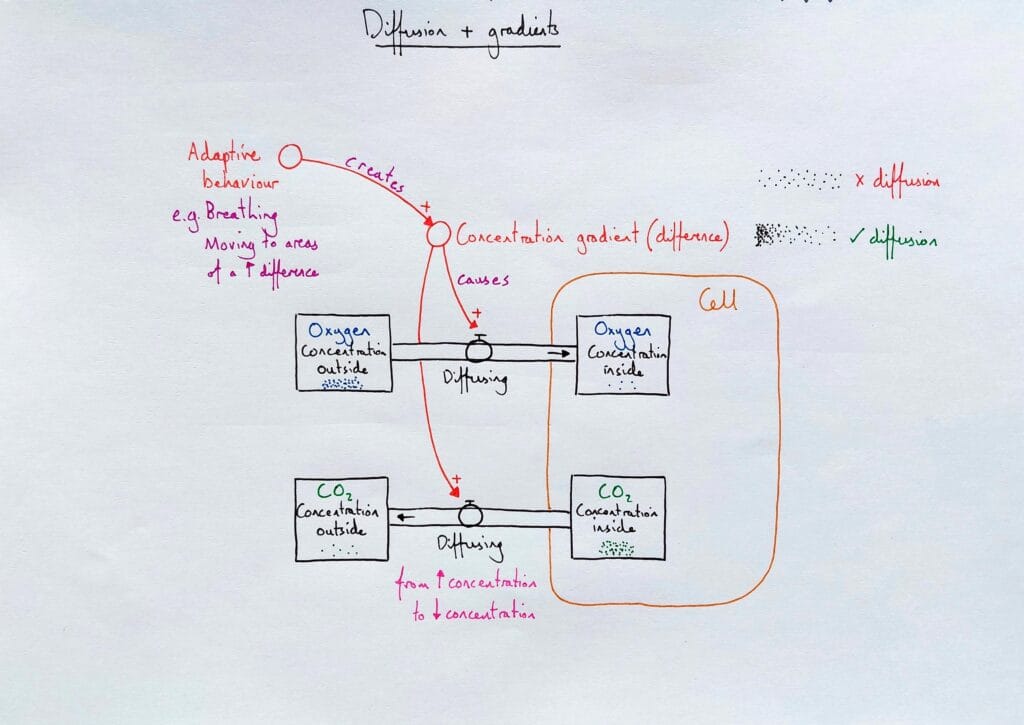
Of the patterns discussed with diffusion (Fick’s Law) there is only one cause of diffusion, the rest just modulate its rate. The cause is a difference, often expressed as a concentration difference but sometimes as a partial pressure difference. The ultimate explanation, then, for the cause of diffusion is the second law of thermodynamics. With the second law, things tend to go from order to disorder. Just like a neatly concentrated gas that then diffuses into disorder. I begin here, with a PHET simulation and discuss why it occurs: as individual particles move randomly, the group will end up filling a space. It’s so unlikely that they’ll move randomly to concentrate themselves that we may as well call it impossible. Eventually, groups of particles reach equilibrium.
That’s the physics, but it’s important not to ignore the biology. So what is the biology? Equilibrium is death. Organisms everywhere depend on flows of energy and matter: stuff needs to get in and out. This means that organisms don’t just depend on concentration gradients; they must actively create them. They do this by moving to different areas or by moving substances. For example, breathing maintains a concentration gradient, as does flowing blood. Swimming through water does too, as does abdominal pumping in insects. See how to teach with stock and flow models in Difference Maker.
Diffusion distance
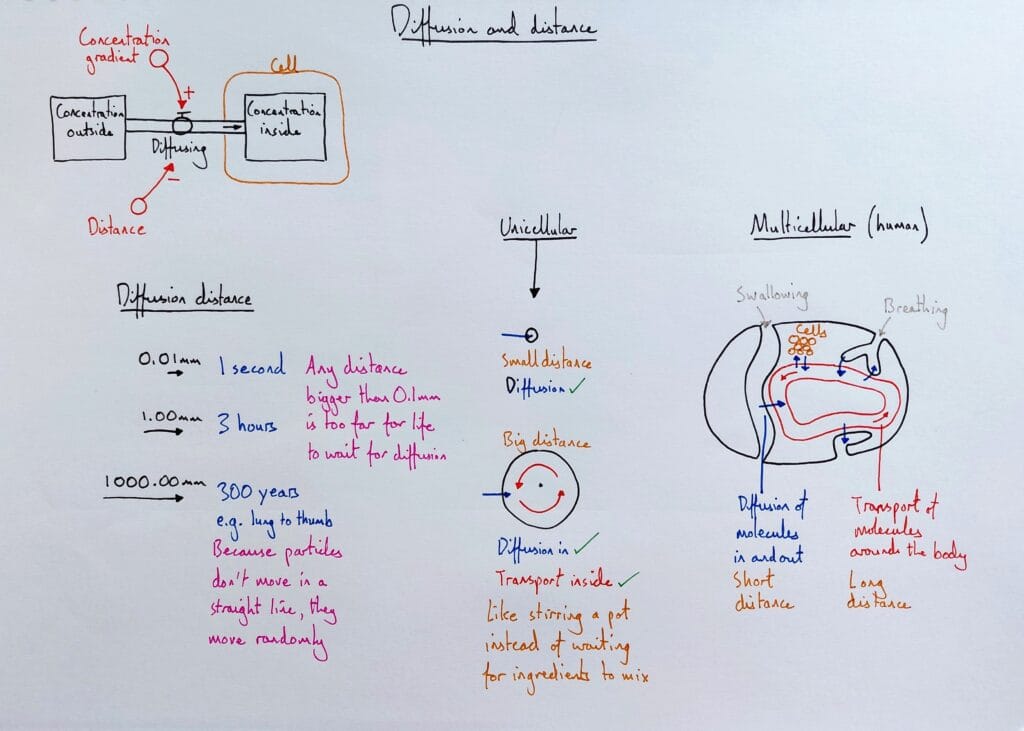
After dealing with the idea of gradients, the next step is to understand how distance affects diffusion rates. Superficially, the idea is simple. The larger the distance, the slower the diffusion. But, as I argue in Biology Made Real, to make this meaningful, we need to see how it affects the form of organisms. To see this, students need to see that the relationship between distance and diffusion rate isn’t linear. With small increments in distance, the rate drops very rapidly to levels that are not viable for life. The smallest organisms can get away with diffusion alone, but as soon as you get just a little bigger, transport systems are required (e.g. cytoplasmic streaming). In this lesson, then, I start on the left, and slowly move to the right of the diagram as we converse and look at examples.
Surface area
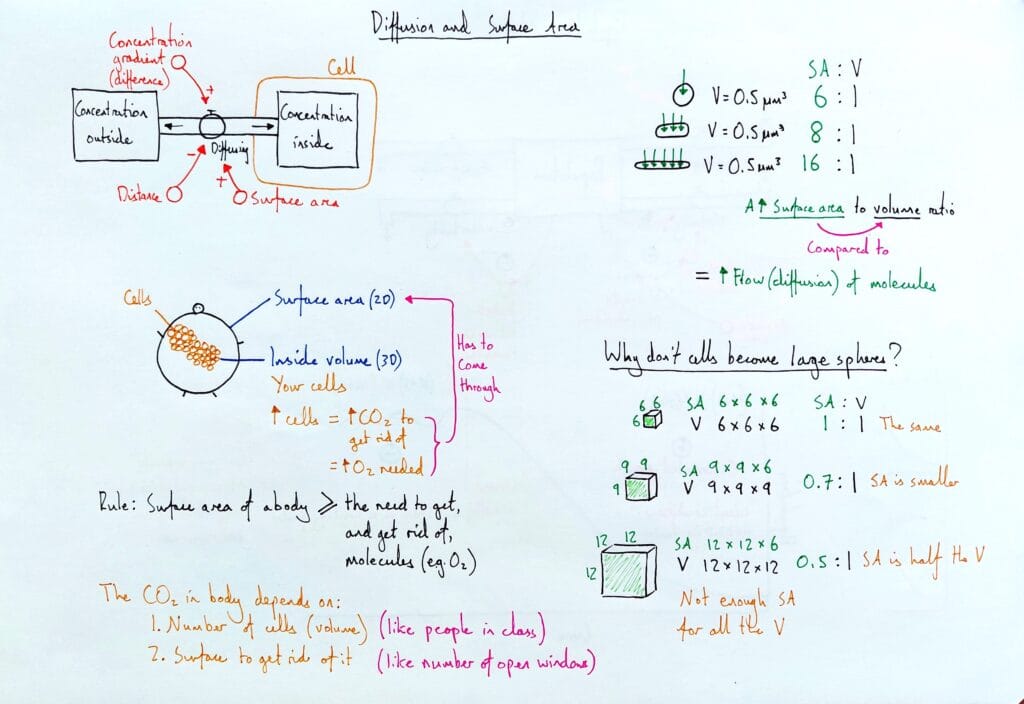
I explain this lesson here.
Surface area calculations
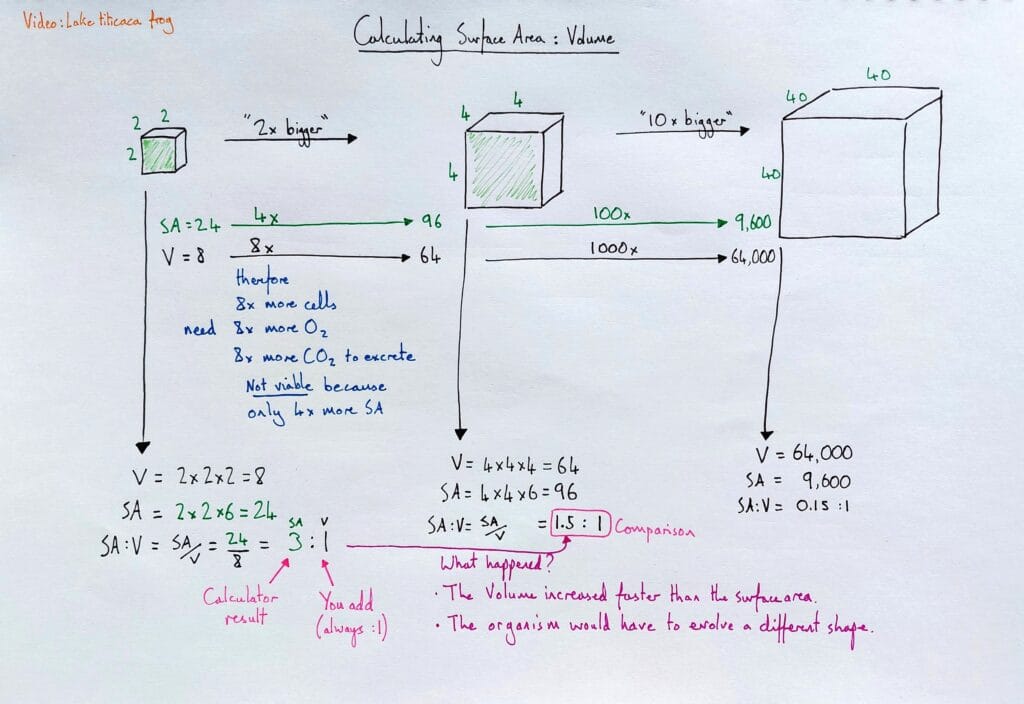
I explain this lesson here.
Want to learn how to teach this way? Check out my books: