Models (11–14): Human Reproduction
The teaching of human reproduction is often a missed opportunity. In Biology Made Real, I explain how meaning in biology arises from understanding how traits affect how an organism lives their life (their ecology). It also stems from their family history (their evolution) and how the traits compare with others.
We see selection’s effects most clearly, not on survival, but on reproduction. Those that reproduce manage to re-produce their way of being (with variety) in the next generation. This makes human reproduction a fantastic topic for discussing variation and selection.
Often, however, this topic spills over into a more social frame. Biology teachers should, instead, coordinate with teachers of courses like Personal, Social, Health, and Economic well-being, so they can cover this in parallel. Human reproduction should remain a conversation on biology.
On this page, I’ll share the models I draw while teaching with my students. Learn how to develop biological models in lessons in my books, Difference Maker, Teaching Meaning, and in my How I Teach posts.
Why does life reproduce itself?

I begin the topic by setting the way of seeing: natural selection. Typically, students come to the topic excited and nervous about why humans copulate. Instead, they must make sense of why all organismal life reproduces itself.
By this point in the course, I’ve already taught a simple model of natural selection, focusing on the two key distinctions: variation and selection. I’ve also discussed DNA, but here we return to it in a bit more detail to answer this question: What if there’s a variety of organisms in a population and some have a propensity to reproduce while others don’t? Those that don’t have a propensity to reproduce die without reproducing, and, therefore, their DNA is lost from the population. As living organisms today, we can trace our family lineage all the way back to the beginning of life; all our ancestors reproduced, and so, we have inherited that lineage’s DNA.
Ovaries and testicles, eggs and sperm

Ovaries and testicles often get little attention; they’re just parts to label with a name and function. But if my first lesson foregrounded natural selection, this second lesson foregrounds development. I use gestures and analogies to help students make sense of how we can become biologically typical males, females, or something else. I point one hand forward and move it away from my chest. Then, I say, depending on whether we have a particular gene in our DNA, we can be nudged towards developing testicles. With my other hand, then, I nudge my hand so it follows a different trajectory. Hence, the diagram above. Then we discuss possibilities, such as non-descending testicles, that can lead us to an alternative developmental path.
The female reproductive system

In Biology Made Real, I argued that a principal way of meaning making in biology is through understanding a species’ evolutionary history and relationships. I suggested, therefore, that we should teach cladograms early and then include them often. I add a clade at the top, give students the options to complete it, and then let them have a go. In the case of the vertebrates, I taught them their relationships when I first taught them cladograms (after teaching them about natural selection), here.
Notice also all the “What if” questions I leave on the diagrams. Learn how to use these to trigger sense making in my books Difference Maker, and Teaching Meaning.
Puberty (and evolution)

My lessons on puberty are never about giggles. They are, instead, about our evolutionary history, which puts in perspective the type of animal we are. Biology is a special subject; we are a bunch of cells learning about cells. As I argue in Biology Made Real, it’s not about learning structures and functions; it’s about making meaning of our own identity. In this lesson, then, we make sense of our life cycle by comparing it with that of relatives (in this case, lepidopterans). Then we make sense of the timing of our changes, and the changes themselves, in terms of natural selection.
Menstrual cycle

I first put the menstrual cycle into the frame of the female’s life; when it begins, and when it ends. And why it ends. Why should a species give up fertility? Surely they should continue to reproduce until close to death. We discuss, then, possible reasons why the menopause evolved, which concludes when I tell them about the grandma hypothesis, seen in other species, such as orca whales.
Male reproductive system
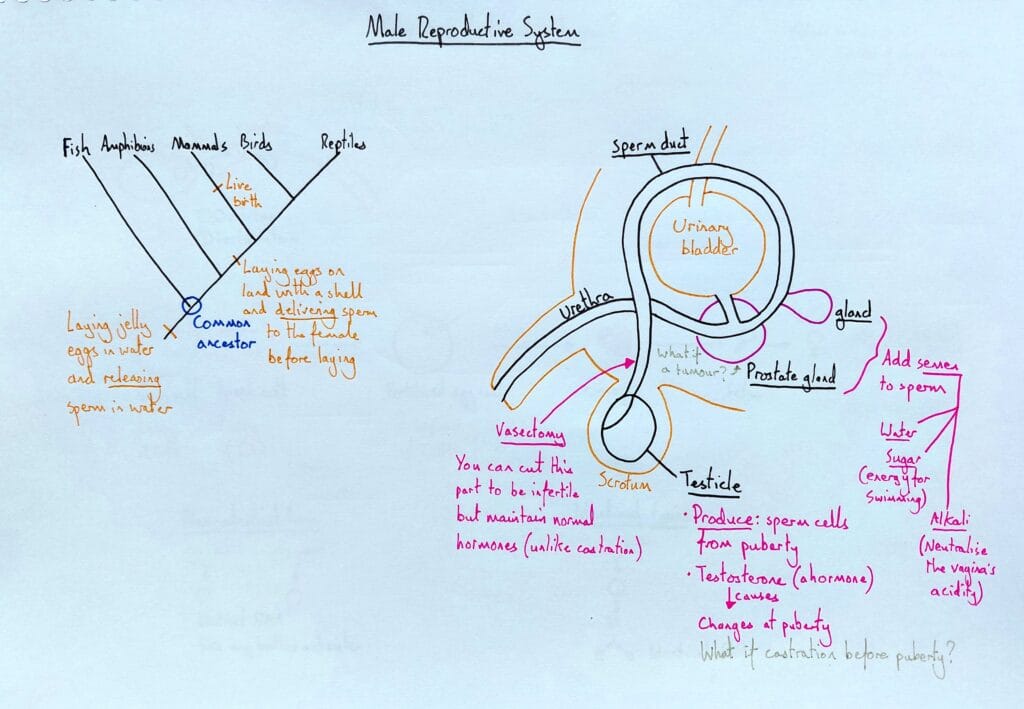
Once again, a cladogram brings the meaning of the system into focus. Notice how I’ve changed the layout from the previous version. When I add mammals to the cladogram, students have to think more carefully about where to place the others.
As in any of these lessons, “What if?” questions are useful for making meaning of key parts. What if we cut the spermduct here? Or here? And, what if a child were castrated before puberty? What about after puberty?
Fertilisation

An important focus in this lesson is how haploid gametes make a diploid cell. This idea will be important for students in years to come, but it also helps them make meaning of their own identity. Much of this lesson, however, discusses twins, a favourite topic for students of this age.
The placenta

The topic finishes with the placenta, a mammalian innovation. A cladogram, again, puts this into perspective. I compare gestation periods; students love to watch a video of a kangaroo giving birth to a tiny fetus.
Learn how teach this way in my books: