How I teach SA:V in biology
Surface area to volume ratio is a fundamental concept that keeps appearing throughout biology. It’s best to get it right the first time. Many times, however, students end up memorising ↑SA is good and ↓SA is bad without it having any meaning. In this post, I’ll show how I explain SA:V, without a slide deck, so students (14–16) understand it.
The meaning of SA:V
Typical explanations of SA:V in biology that I have seen go something like this:
- Cubes of different sizes are shown with their measurements, illustrating how the volume increases more quickly than the surface area.
- This limits cell size due to the increased diffusion distance to the cell’s centre.
- The lesson then moves on to examples of exchange surfaces in humans, which have large surface areas (lungs, intestine, placenta).
Many things are missing from these explanations, most importantly: what it means for an organism’s life. Why does it matter if cells can’t be large cubes?
The flow of energy and matter
I only begin teaching SA:V after teaching students about concentration gradients and the effect of distance on diffusion. So, to warm students up, I draw a simple stock and flow diagram and have students complete the names.
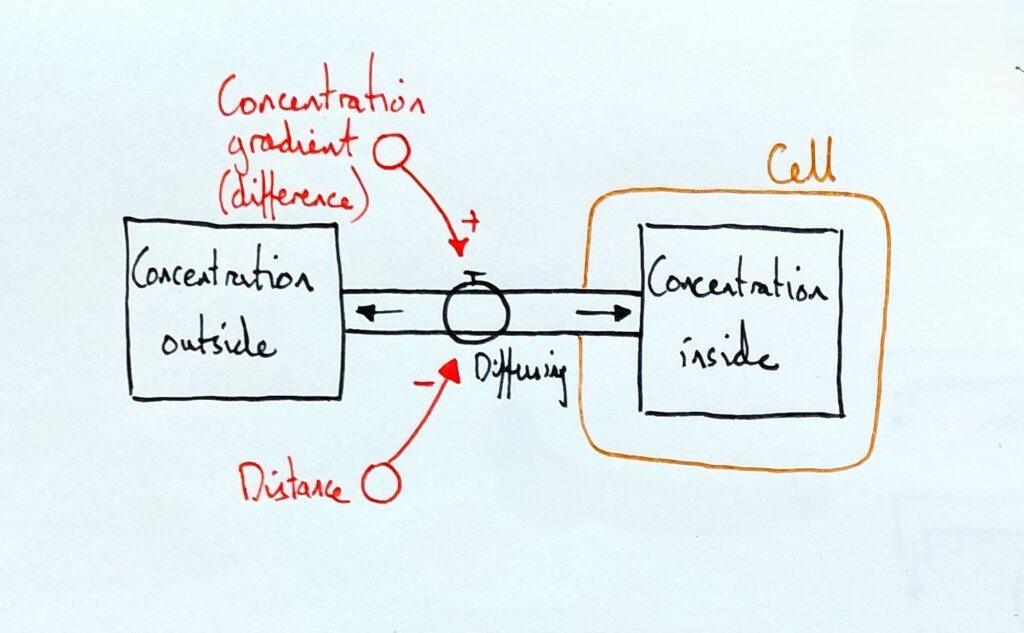
What matters is the focus on the flow. I give the students a rule that organisms must follow:
The flow of energy and matter MUST MATCH the demand of the living system.
What if they don’t? In the worst case, they starve, they can’t maintain their parts and begin to disintegrate. But maybe they don’t, and the problem is relative. Others in your population are gaining energy and matter faster, and they outcompete the rest.
To see this, I take my students to an unfamiliar world: uniceullular organisms
Begin with unicellular organisms in ecological context
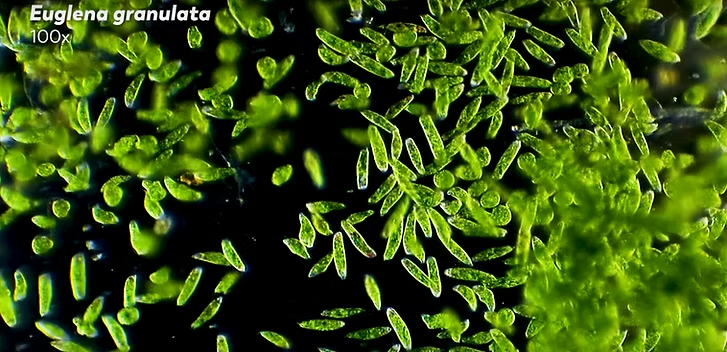
Journey to the Microcosmos, a youtube channel, offers fantastic videos to explore the shapes of cells as they go about living their lives. Here’s a video with a lot of footage that fascinates students. We watch the cells move with purpose, trying to go about their day in order to survive. What are they looking for? Energy and matter.
Why do these unicellular organisms have this shape?
Next, I focus on shape: what shapes can they see? There are spheres and rods, generally, but why?
The typical lessons miss this crucial step. They jump straight to different-sized cubes: all the same shape. Why does it matter? When you change the size of a cube, you change two things at once. Both the surface area and the volume change, and that makes it difficult for students to distinguish them.
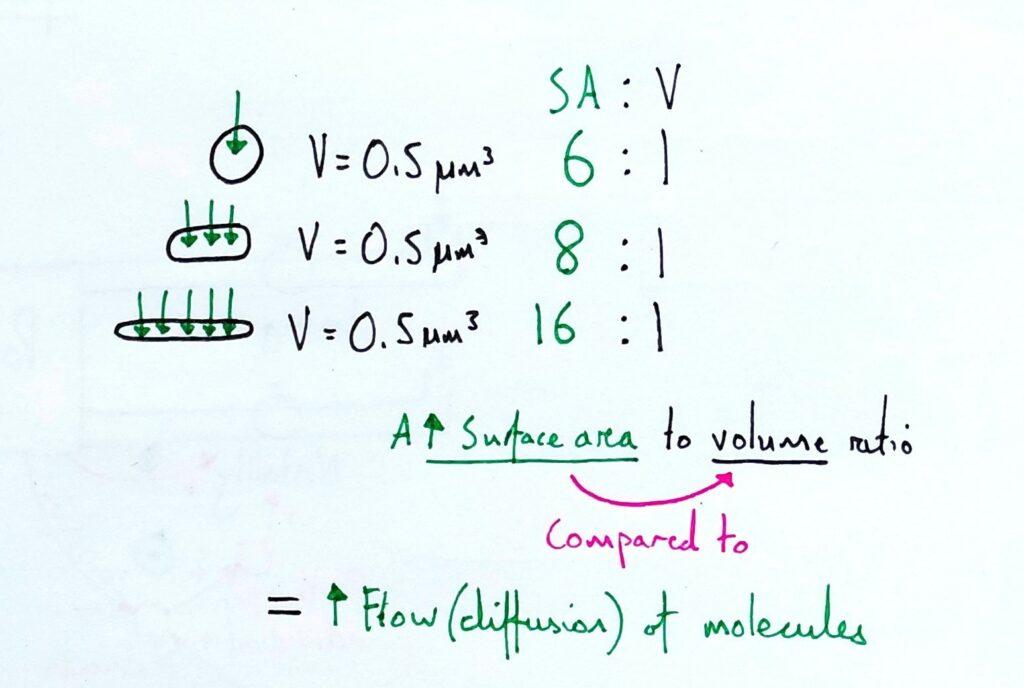
Variation theory tells us to vary one thing at a time, either the surface area or the volume. Varying the shape of a cell allows us to vary only the surface area, while keeping the volume the same. Thinking back to our rule, therefore, we can vary the flow of energy and matter, while keeping the demand the same.
A concrete analogy
Following these questions, I demonstrate the effect of shape using an analogy for diffusion: the conduction of heat.
For this, I have two pots of heat-sensitive putty, so that both have the same volume (don’t mix them). For better results, have them in the fridge before the lesson. One I shape as a sphere, and the other I squash into a rod. Then I ask students to make predictions: which will warm up the quickest?
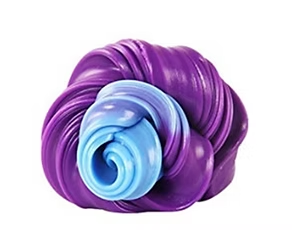
I drop them into 1 L beakers with hot water. Using tongs, I pull them out immediately. I then slice them in half, and students can clearly see the difference. The sphere maintains a larger “cold” region.
Back to diffusion
I draw a blob man to highlight the distinction: the volume is the living part of the organism, but the energy and matter must come through the surface.
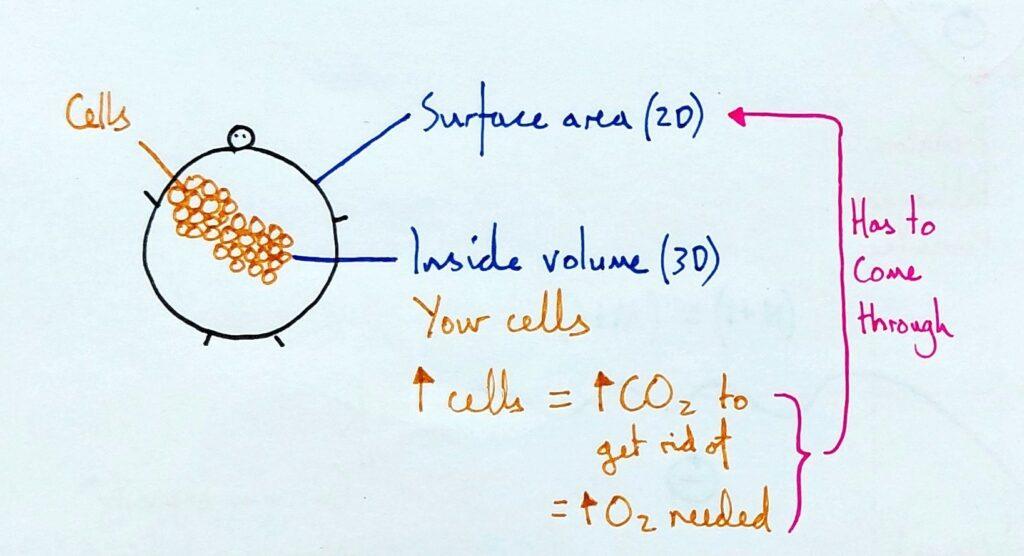
The problem lies in their form. The volume is three-dimensional, whereas the surface has just two dimensions. My students find this bit tricky, so I ask them to think about a basketball. If I filled the ball with water, could an insect swim around? left and right, forward and backwards, up and down? Then the volume is 3D. But if I place the insect on the surface (let’s say it can’t jump), it can only move left and right, forward and backwards. It’s only 2D.
Vary the surface to see its meaning
The most successful analogy I’ve used so far is the classroom. My students fill my classroom with carbon dioxide, and I ask the students what we can do about it. Open a window! But by how much?
The windows, I explain, are the surface. What if I don’t open the windows enough? The carbon dioxide accumulates as it is produced faster than it can leave.
Vary the volume to see its meaning
What if I invited the class next door to enter our room? What would we have to do with the windows? Open them more. Here, I varied the “living volume” (the number of students), and they typically find it intuitive. If there’s more living volume, you’ll need a larger surface to exchange the gases.
Seeing SA:V in cells
Next, I draw simple shapes, a continuum between spheres and rods with the exact same volume. And I ask students to vote (by raising their hands) on which will have the faster rate of diffusion. Their votes help me see how well they’ve understood so far and what move to make next. I then add the arrows to illustrate the larger surface through which matter can diffuse.
The ecological meaning
In Biology Made Real, I discuss a trait-spectrum question. The trait here is the cell shape, and the spectrum extends from a sphere to a really skinny, elongated cell. Trait-spectra are important to avoid students thinking in dichotomous traits (such as black or white, spherical or rod), as was observed by Alred et al. (2019).
This allows for discussion of trade-offs in life, due to ecological pressures. Too much, or too little of something might be disadvantageous; at what point is the trait most fitting, where is the Goldilocks zone?
If a larger surface area is better, why not form an incredibly elongated cell? You could discuss predation trade-offs: could a predator move well with such elongated shapes? Could a prey cell be consumed easily if it were really long?
Or cell unity trade-offs. If cells become too long, may there be a problem of communication with the nucleus?
It’s possible to use examples such as filamentous cyanobacteria; why don’t they arrange into a sphere? Other examples of unicellular shapes can be found and discussed comparatively in the Microcosmos videos.
Shape matters! Not just size. Cell sizes are limited, yes, but species evolve, and organisms show phenotypic plasticity. Organismal morphology is typically not cube-like, and shape is an important variable for survival and reproduction.
Crucially, through exploring shape, I’ve been able to help students distinguish surface area from volume, two distinct aspects of SA:V.
Time for the cubes: How about just having a larger cell?
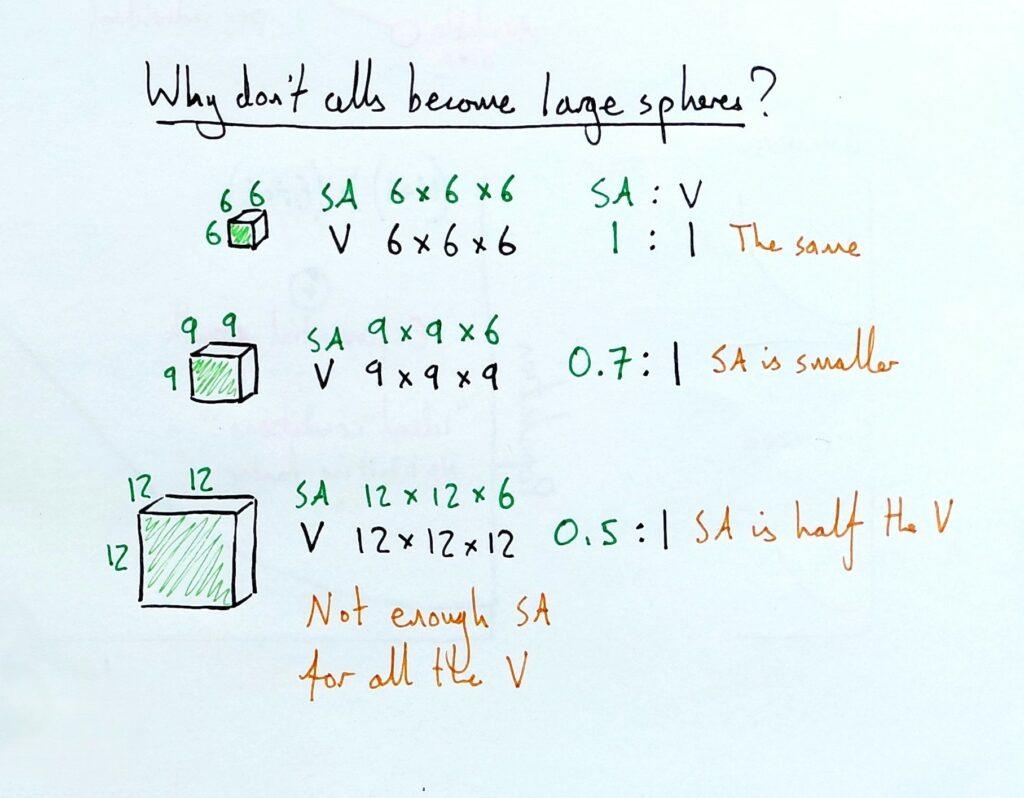
To finish this lesson, converge more with typical lesson explanations. Why don’t these cells (whatever examples you’ve been looking at) just get bigger while maintaining their shape?
I introduce the cube example, in which both volume and surface area change at the same time. We calculate the surface areas and volumes together. They see that the volume gets bigger quicker than the surface area, and I represent this in the ratio.
Lesson 2
Surface area to volume needs time. Its an abstract by fundamental concept in biology. In the second lesson, I show students how to calculate it (from cubes) and extend the concept to multicellular organisms.
Firstly, I set the context. I ask them to imagine a version of me that was 2x taller, 2x wider, and with 2x more depth. Would they call that a giant? Yes, they would. I teach them how to calculate the difference:
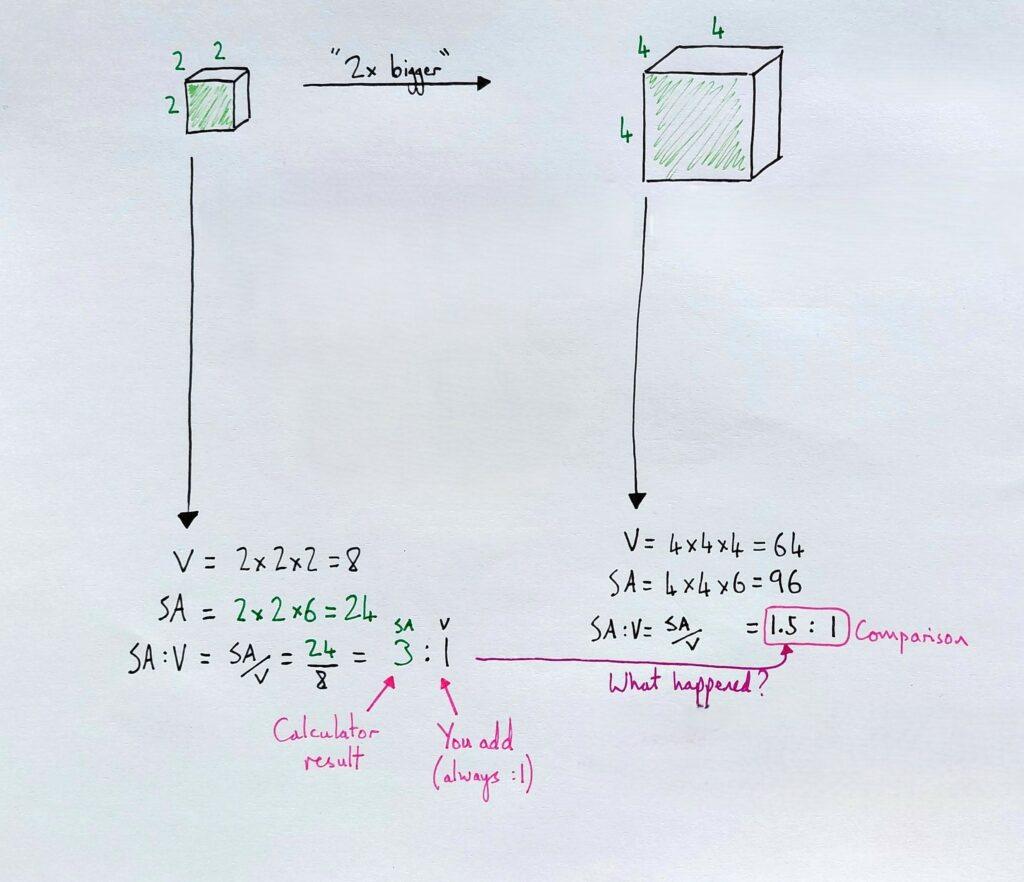
Then the mystery: if the giant got bigger, why did the SA:V get smaller? Many students find this confusing. So, one by one I ask them to calculate how many times bigger the SA got, and the V got, individually.
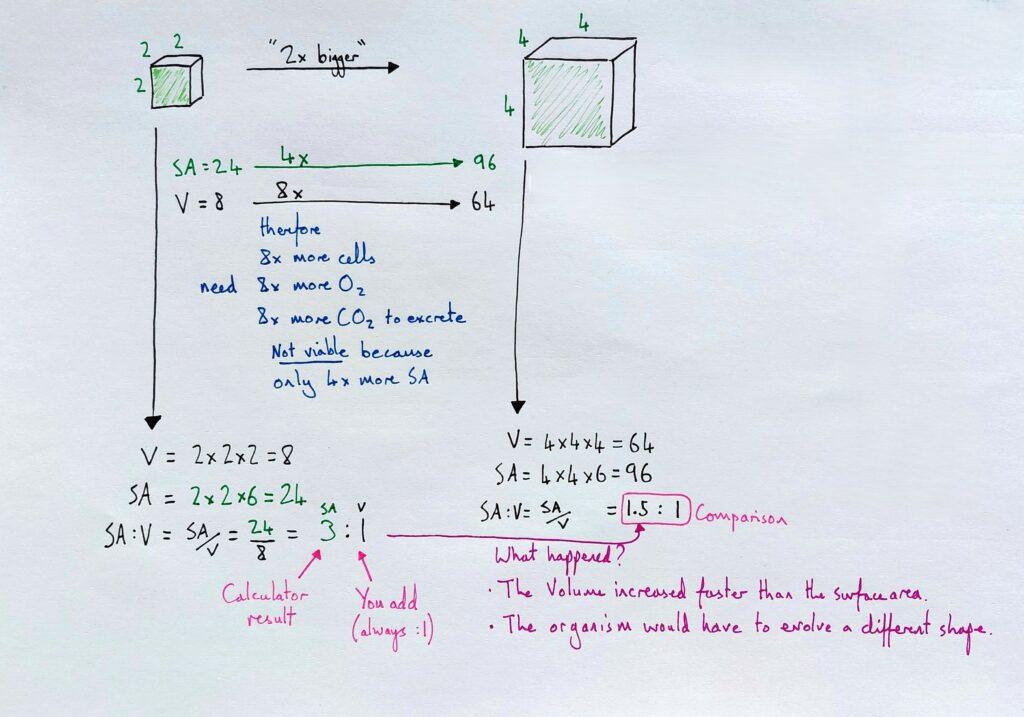
The surface area got bigger, 4x bigger, but the volume got 8x bigger. So, the surface area went from being 3 times bigger than the volume, to just 1.5 times bigger. That’s the SA:V. But what does this mean for the giant?
The giant would need 8 times more of everything to feed 8 times more volume, but it would only have 4 times the surface to get it into the body. The giant wouldn’t be viable. In other words, giants with the same shape as us, wouldn’t be viable. To get bigger, you must change shape.
To help students see how multicellular organisms can evolve to change shape when getting bigger, I show them the Lake Titicaca frog.
Examples in humans
It’s finally time to explore examples in humans. If humans have got so big (medium sized mammals), how did we manage it? A lung surface area as large as a tennis court and similar for the intestines.
What next? Teaching it in context
Rather than showing many examples in humans and then moving to a distinct topic. I prefer to look at one example in detail. The other examples will come in time as we proceed through the curriculum. Therefore, after these lessons on SA:V I move to study the lungs.
The reasons for this are several:
Firstly: The adaptations of pneumocytes and alveoli for gas exchange are simple and intuitive. If you begin with the intestine, you have to introduce microvilli, villi, and intestinal folding as your first example.
Secondly: The SA:V of the gas exchange system correlates well with the metabolic demand of the living biomass. This is because most animals hold negligible oxygen stores. This makes it easier for the student to link the morphology of the lungs with the flow of energy and matter (in this case O2 intake and CO2 excretion rates).
With the digestive system, more factors can confuse. We hold large stores of organic matter for later use. We also have the processes of digestion, and egestion of organic matter that is not absorbed.
Thirdly: Related to the second point, the relative simplicity of the gas exchange system of humans compared to the multi-compartment digestive system, means that comparative biology is easier.
At it simplest, the lungs of humans (and mammals) can be compared to those of amphibians and reptiles, but this can easily be extended to other organisms. With the multiple examples students can begin to discern the core patterns of gas exchange, while the differing morphology can be used to enhance a discussion of their ecology and evolution. Why do amphibians have smaller lungs compared to mammals? Why don’t they evolve a larger SA:V? et cetera.
If this post resonated with you, learn more about how I teach biology in my books:


References
Alred, A. R., Doherty, J. H., Hartley, L. M., Harris, C. B., & Dauer, J. M. 2019. Exploring student ideas about biological variation. International Journal of Science Education, 41(12), 1682–1700.