Helping students develop study skills: a simple model
Advising students how to study is complex. Learning is messy, with ups and downs. Sudden insights may punctuate periods of seemingly little change. But when students are working for themselves without our guidance (i.e. at home), they need something simple to follow. Below, I offer a study guide that’s worked for my classes and those of colleagues in other subjects.
Take a look before I discuss it below.
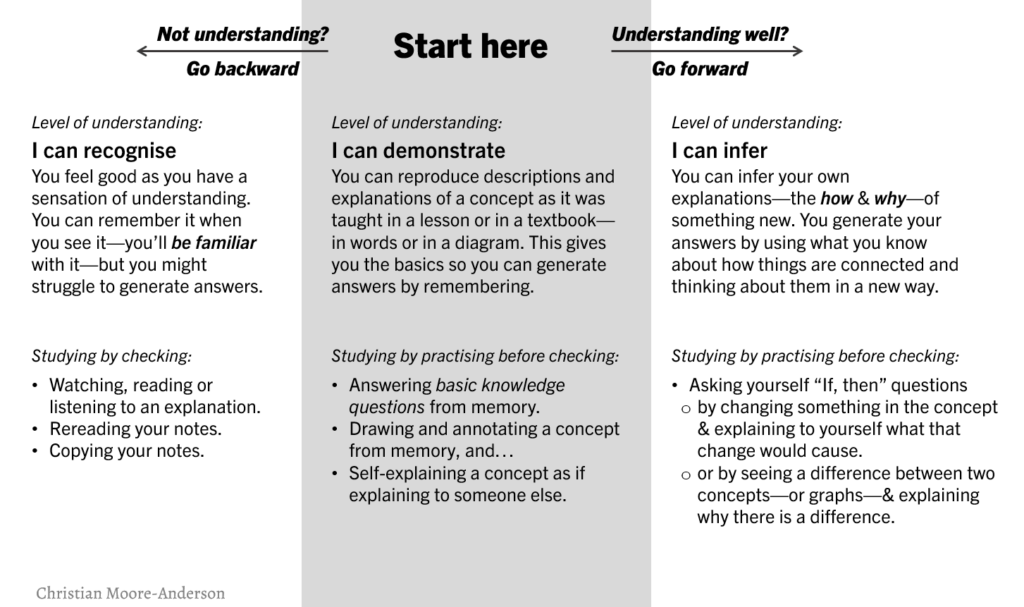
It’s not perfect; no model can capture it all. Yet its simplicity has proved useful for conveying important ideas to students. Many students think that reading and rereading is how to study. They get a fuzzy “I understand” feeling and when they receive a disastrous exam result, they are distraught. They can’t believe the mismatch between the outcome and their mental model.
And you know what? Fair enough. They’d devoted time to their study, they’d taken it seriously. It’s disappointing when expectations don’t match experience. Even so, I realised that they often didn’t learn their lesson, and the same would happen again later in my subject and other subjects. My guide clearly distinguishes between familiarity (and being able to “follow” an explanation) and being able to generate answers for yourself.
To generate your own answers, you have to know your stuff, so students must practice re-presenting concepts: by re-drawing, or re-calling the facts they need to know.
Yet, we have to be careful, there are also the crammers and rote learners. Many study this way. Yet, when they’re asked to explain something novel—like a new context or a variation in a concept—they can’t. So the next distinction I’ve made explicit to my students is the difference between description and a flexible understanding with which they can infer and make predictions. This step is important, not an extra, because the meaning of ideas is found in how they could be different, change, or vary.
The correlation between ways of studying and learning outcomes is highlighted. But it also guides students on how to organise themselves. It invites them to begin by generating answers instead of merely reading and rereading. From here, they can either move forward or backwards depending on how they feel. This gives agency and invites students to practice their metacognition.
Even so, even with this neat model, my students won’t follow it unless I have them read it in a lesson with me, and then spend the rest of the lesson enacting it. Maybe later we’ll repeat the process because getting students practising “how to study” is harder than one would imagine.
If my model provokes some new thoughts, feel free to adapt it to your students, subject and context. Learn more about teaching meaning in any context in my book: