A model for teacher sustainability and growth
What are the most important factors for teacher sustainability? I’m sure there are many: behaviour, planning time, teaching hours, pay, etc. I’ll look at just two factors that, together, provide a rough rule for deciding whether an activity or assignment is sustainable.
The two factors are 1) how much these activities develop the student, and 2) how much they develop the teacher. Crossing these continua, we get this:
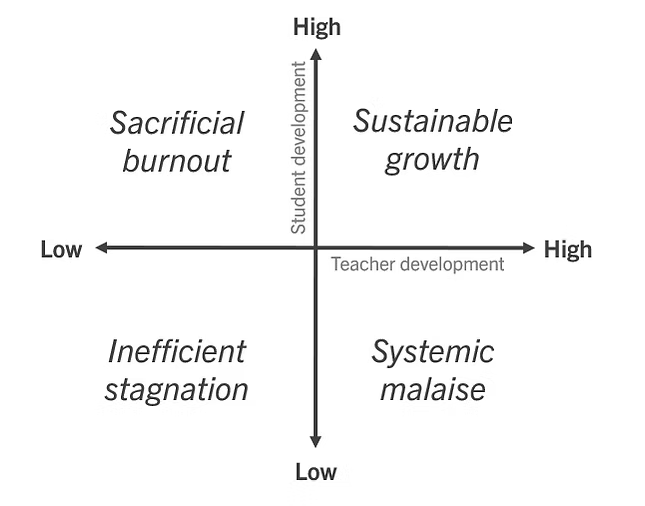
While we have a mix of activities in our teaching practice, only those that develop both teachers and students are sustainable. It’s a rule that I’ve stuck to since I started teaching.
To be sustainable, a teacher needs to benefit from experience so that the job gets easier. As it gets easier, more time and mind are freed to ponder pedagogical changes, curricular innovations, new subjects, and mentoring others.
When teachers don’t develop, the job remains as hectic as it is for early-career teachers. This can lead to burnout.
When students don’t develop, there’s general malaise in the system. Students and management become unhappy, which feeds back to the teacher’s experience. This is also unsustainable.
We could, of course, add more variables and say, “It also depends on X”. The power of this model is in its simplicity for making certain decisions. Here are some examples:
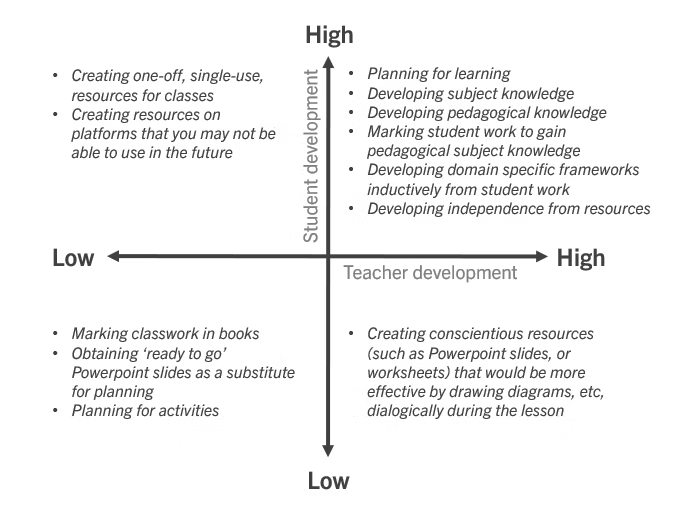
For example, if you’re marking students’ work, make sure there is something in it for you. Just marking classwork doesn’t produce robust feedback loops. Students and teachers learn little from the process.
Instead, marking should be focused. For example, on a piece of writing designed to reveal how our students think about the content we’ve taught. This prompts feedback loops that allow teachers to respond to students by adjusting teaching and curricula. Crucially, it also allows the teacher to learn about their own teaching.
Another example is how I spent a year teaching by drawing on the whiteboard. It was great for student development, and they appreciated my diagrams built through dialogue. But I had no record of those diagrams or lessons. Without them, I had no record of my thinking and no way to improve those thoughts for future lessons.
I made my teaching more sustainable by teaching with a visualiser and taking a photo of my explanations at the end of every lesson. Over the years, I’ve been able to modify and refine my diagrams and models. This has benefited both my students and me.
I’ve found that, as a ‘rule of thumb’, it can be useful. When I think about new activities, lessons, and work to be marked, I wonder what I can learn from them: what idea I can put to the test. If you want to see how I teach, see my book, Teaching Meaning.