How I teach the role of fungi in ecosystems
The role of individual organisms is vital to understanding ecosystem functions. Yet, the organism and how it goes about its life are often left in the background. Abstract energy flows, and nutrient cycles take the focus.
Students are familiar with their own role in consuming and the growth of plants. Fungi, however, are typically more elusive. To begin understanding nutrient cycling, students need to explore the lives of fungi themselves and how those lives fit into the cycle.
In this post, I’ll show how I’ve done this recently with my 11-year-old biology students by drawing a stock and flow model. See how I introduce stock and flow diagrams to students here.
I started by drawing these stocks and flows:
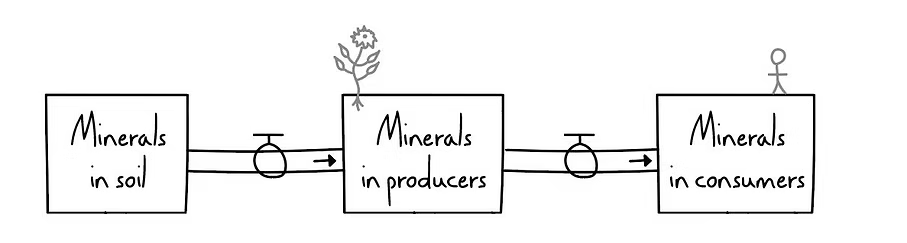
The students found the general idea intuitive. We’d already studied food chains and they were familiar with consuming plants. But what are “minerals”?
Minerals are a form of nutrient. To prompt students to perceive the idea, I needed to contrast it with another form of nutrient. We’d already discussed the principal organic molecules of life, so we went over examples again: fats, proteins, carbohydrates, and DNA.
I told them that we weren’t discussing these; minerals were different. I gave them examples, some of which they’d heard of through popular knowledge. For example: magnesium, potassium, and “salts” in general. But what makes the difference? While producers produce their own organic molecules, minerals must be absorbed from the soil.
Hence, the flow (in the model) goes from soil to producers. Now we needed to name the flows. I asked the students to discuss this in pairs, and then we agreed as a class to add the names: absorbing and feeding.
After this, I added the connectors from the stocks to the flows with a + sign:
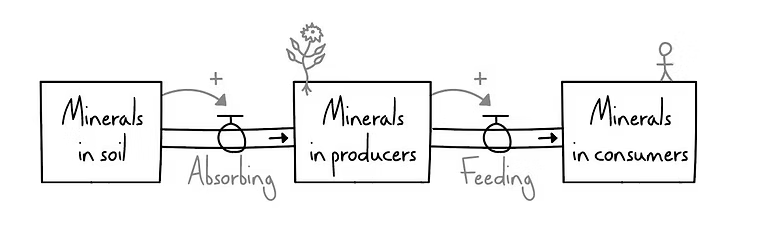
- ⊕ means: ↑X, ↑Y; or ↓X, ↓Y, (I call this “Same”)
- ⊝ means: ↑X, ↓Y; or ↓X, ↑Y, (I call this “Opposite”)
So,
- the more minerals in producers, the faster they flow to consumers.
- the more minerals in the soil, the faster the absorption rate.
As we add to a model, I like to ask students if the new additions make sense. This prompts students to explore the model’s meanings. For example, I asked these questions:
“If some soil has more minerals than normal, would the plants obtain more minerals than normal?”
“If the plants in an ecosystem had more minerals than normal in them, would the animals there also obtain more minerals when they ate them?”
In conversing, the students agreed it made sense.
From here, it was time to start thinking about fungi. To get there, I needed to provoke my students to mentally act. I traced the flow with my fingers and narrated as I went. When I got to the final stock, I asked where the minerals went next:
“According to the model, the minerals just accumulate in the consumers. Eventually, if this model were right, all the minerals would be stuck in the consumers. Where would the producers get their minerals from then?”
In a class discussion, some students referred to dying, others mentioned decomposers. I followed the first line of thought, as this is where I wanted to go next. I added another stock to the model and labelled the new flows:
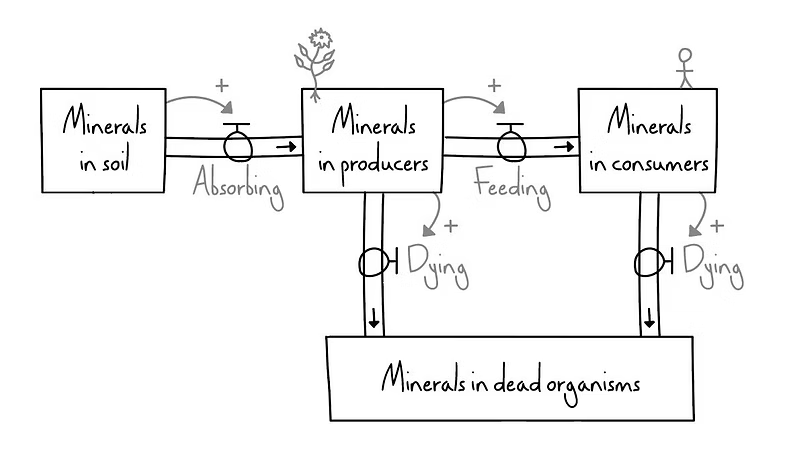
I let my students discuss this question in pairs, and then again, as a class, I traced my fingers over the model.
“Now it suggests that the minerals are released from living producers and consumers when they die. But the minerals just accumulate in dead organisms. If this were true, there’d be no minerals left in the soil, and there’d just be dead bodies lying around everywhere. Why don’t we see those dead bodies?”
And here returned the calls for decomposers. But what are they? It was time to meet the fungi. I added another flow and stock. I labelled them and told the students we needed to see what these fungi looked like and think about how they lived. We viewed images of fungi and watched time-lapse videos found online.
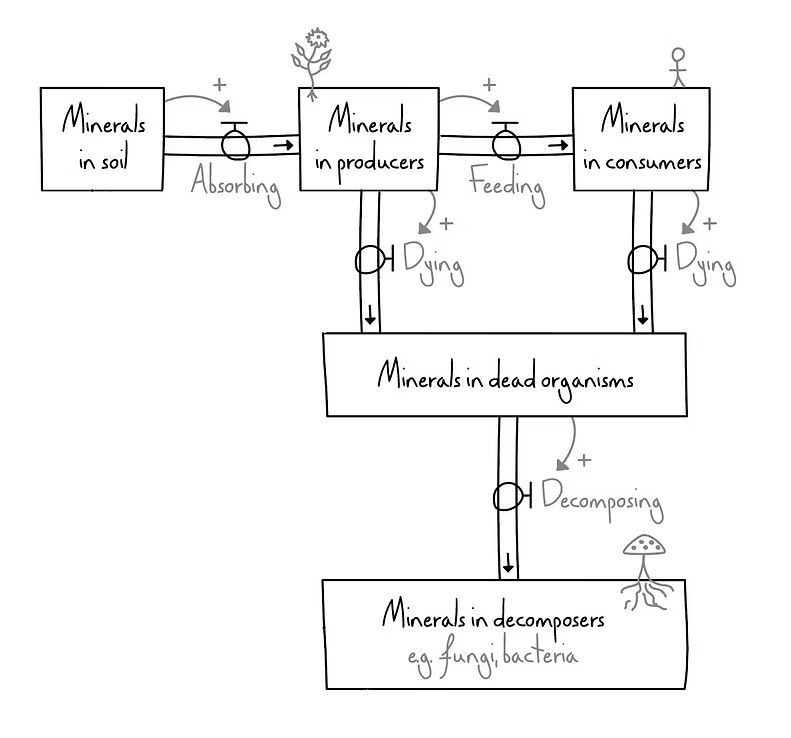
Throughout these, I questioned students about what the fungi were doing. A pivotal question was if fungi were more closely related to plants or animals. Via a vote, the majority thought that they were more like plants. This is a common conception of students and entirely predictable. They see fungi growing slowly, out of soil, and in non-determinate branching ways. There are similarities; the crucial difference (that makes the difference) is hidden from the eye.
To see fungi decomposing something like a log and perceiving that they are taking its molecules and building their structure from them. They are heterotrophs, like us. This is how they grow in size. I point out that decomposers are autonomous organisms, not acting for the “greater good” of the ecosystem. They are simply carrying out their way of life.
“If you buy an orange, leave it in your kitchen, and aren’t quick enough, a fungus will have it before you.”
Finally, I explained to students how fungi decompose more quickly when temperature and water availability are optimal. In rainforests, fungi decompose rapidly but in deserts, they struggle.
It was time to finish the loop as the model didn’t make sense yet. Minerals don’t accumulate in decomposers forever. “How do the minerals return to the soil then?”
This is a crucial step, in my opinion. The mechanism for this action is often hidden from students. Without it, it’s easy to hold a conception of fungi as benevolent and selfless beings that “recycle” nutrients for everyone else. It denies them their equal nature as autonomous organisms and, therefore, causes confusion about what fungi are.
I propose to students that when fungi die, their cells break up and the minerals are released back into the soil. This is enough to preserve the focus on the autonomy of fungi (to live their way of being) in a manner that also promotes nutrient cycling.
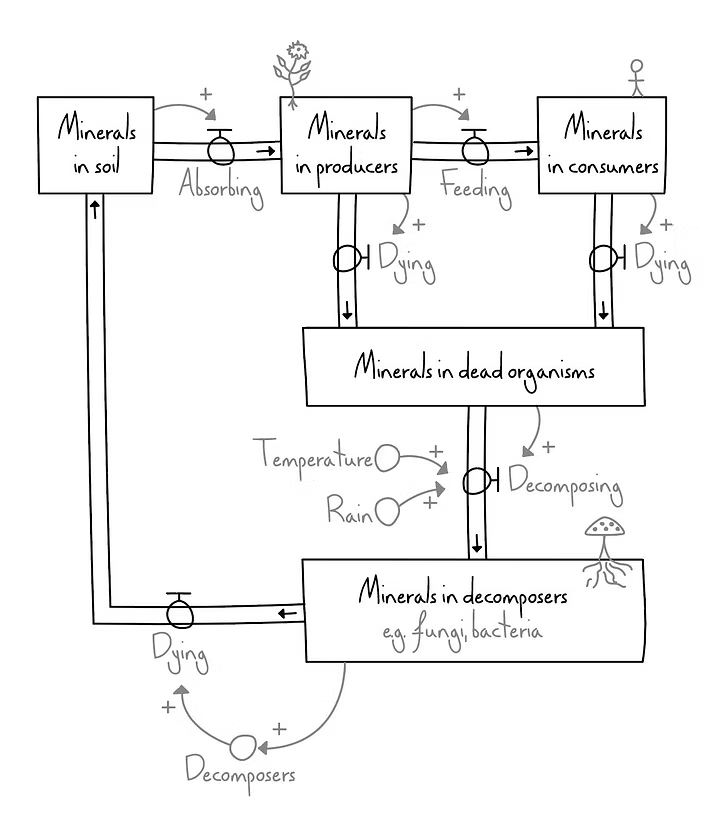
To finish, I shifted the focus back to the whole model. Now we had a cycle, plus all the connectors that show “the more here, the more will flow onward”. I emphasised this and narrated the flows as I traced them with my fingers.
The key here is to show how organisms act in their own interests of self-preservation. However, the systems have evolved so that these actions feed into each other, producing stability for the whole ecosystem. Learn more about teaching this way in my books: