How I teach the relationship between photosynthesis & respiration in plants
The relationship between photosynthesis and respiration (within an individual plant) isn’t easy for students. Often, I find, they’ve been shown the respiration equation so many times that they’ve memorised it, yet still don’t fully grasp its meaning.
Then photosynthesis comes along, and when they’re shown that the equation is the reverse of respiration, it’s just like you’ve reversed the word order of a peculiar sentence. The meaning of that reversion isn’t clear. Here’s how I’ve helped students perceive the meaning.
A stock and flow diagram can make a huge difference. See how I introduce stock and flow diagrams to students here. Consider this one that I show to my students (14–16). The flows have taps that indicate the flow rate can be faster or slower.
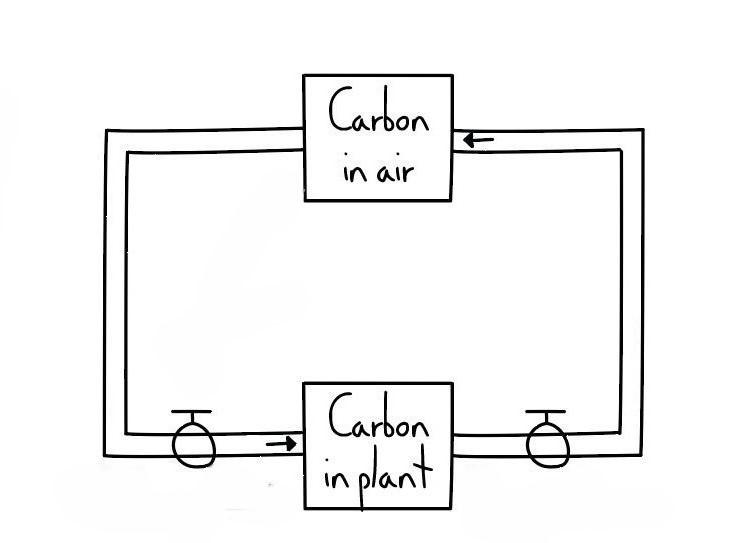
This model keeps things consistent by only referring to the flow of carbon. Carbon in the air represents carbon dioxide. Carbon in the plant consists of all those organic molecules that contain carbon, e.g. carbohydrates, fats, and proteins. So, what are the two processes, the inflow and outflow of carbon in a plant? That’s the question I give to my students.
I let them discuss it in pairs, and after some deliberation, many think that the inflow is photosynthesis, with the outflow being respiration. I have the class vote on whether they agree to get a glimpse of their thinking. I then write down the processes in their corresponding places:
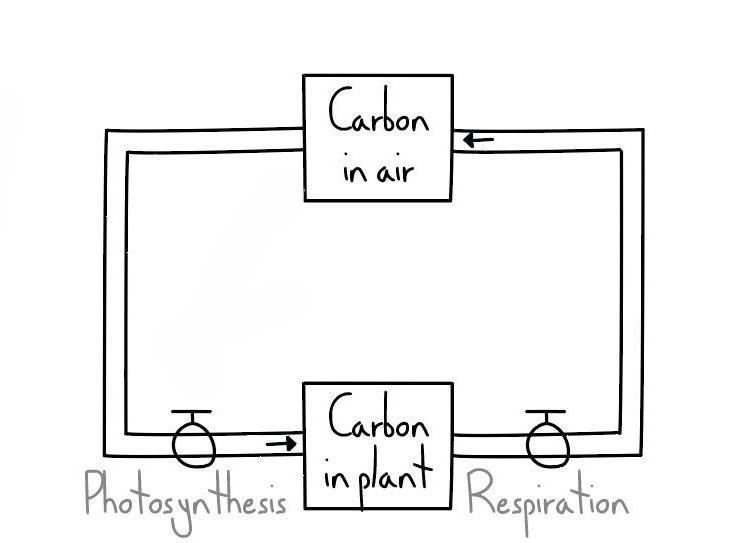
Some students nod and agree, but at this point, it’s often clear that they need more time to make sense of it. And I need more information about what they understand. I ask some students to justify their choices and have the class vote on whether they agree or disagree by raising their hands.
I then help the class by adding the photosynthesis and respiration equations. Before writing them, however, I get them to discuss in pairs what they think they are, ask some students their thoughts, and again, have the class vote if they agree.
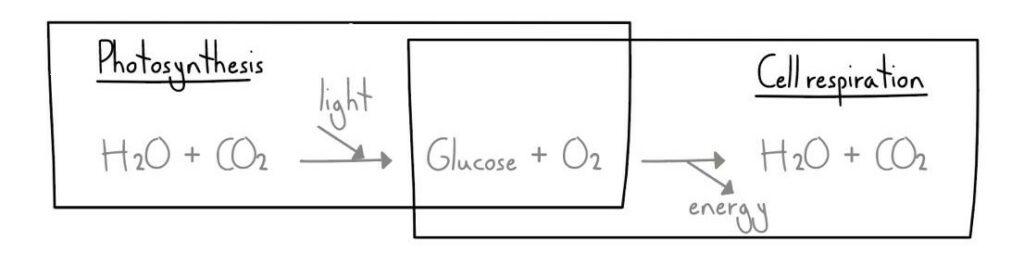
What’s key here is not the focus on energy. But in that central section, we find glucose (or organic molecules) that will serve as the building material of the plant. I emphasise to students the connection between the stock “carbon in plant” and the products of photosynthesis. Why is the carbon in the plant? It’s in the molecules that form the plant. They are the plant’s structure.
Thinking this way is key to my courses, so it’s not so novel for them. I always begin with lessons on simplified models of autopoiesis (as explained in Difference Maker). But this model makes it clearer to students.
Yet to move on, I first need to think about what affects the rate of photosynthesis. Only by having in mind how photosynthesis can vary will they better see. This is a central tenet of variation theory.
I ask them to discuss the question in pairs again. Using their knowledge of particle theory, and plants, they often come to the answers of light intensity and temperature. By pointing to the photosynthesis equation, I help students see that the concentration of carbon dioxide also matters.
Depending on the class, I also like my students to think about the capacity to absorb that light. I summarise this as the chloroplast density, which could be in a cell, a leaf, or the whole plant.
As we discuss the class’ examples, I add them one by one to the model, which ends up looking something like this:
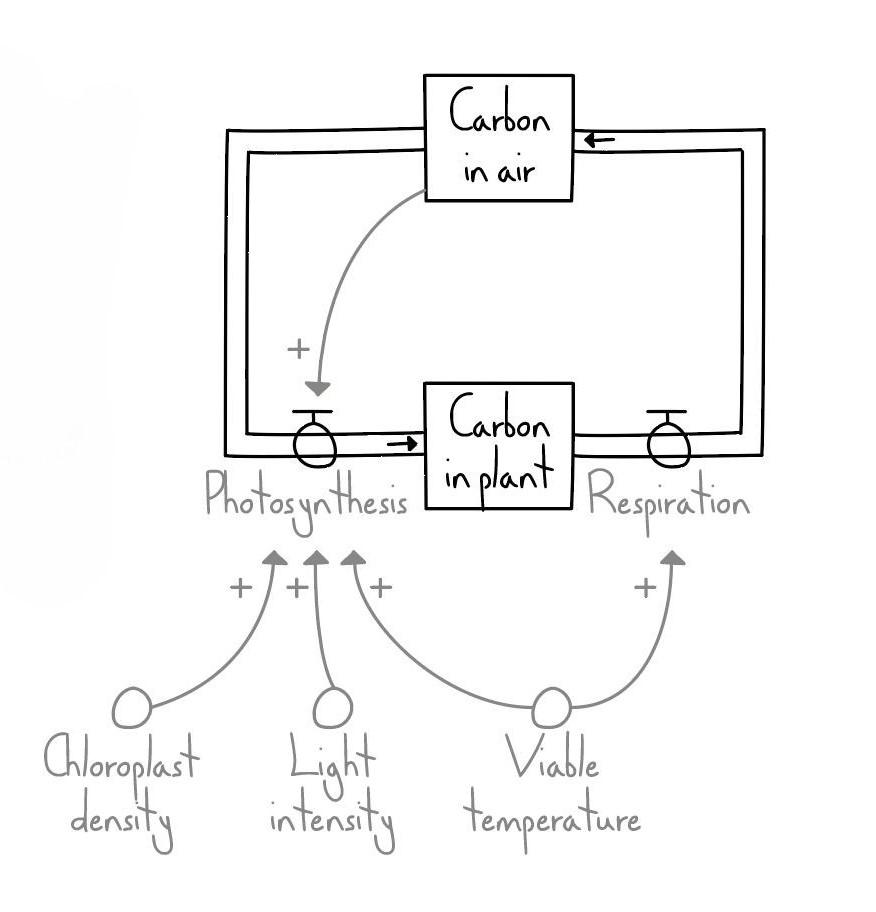
Depending on the class, I may ask them to think of the major factors affecting the rate of photosynthesis. Other times, I might draw the circles on the diagram so students know how many I expect. Each time a student offers a factor to add, I’ll ask the class to vote if they agree or disagree, and I ask students to justify their ideas. When I accept a factor, I’ll draw the arrow, and then ask the class if the connection is “same” (positive) or “opposite” (negative).
Same: higher X, higher Y, or: lower X, lower Y.
Opposite: higher x, lower Y, or: lower X, higher Y.
After the class has voted, I’ll present the idea and ask if it makes sense, for example:
“The higher the light intensity, the higher the rate of photosynthesis. Does that make sense? Why?”
Although it might not seem immediately pertinent, all this talk of varying photosynthesis rates is key to the next step. As with water in a bathtub, a plant’s carbon quantity depends on how quickly it enters (photosynthesis) and leaves (respiration).
Students need to have a feel for how these processes can vary before I provoke my students with some questions:
“On average, which process do you think is running faster in a plant? Photosynthesis or respiration?”
Asking this question without the diagram would be asking for trouble. With the diagram, students can trace the flows with their fingers. Yet, they still need help connecting the idea to their lived experience. After giving them some time to chat in pairs and listen to their ideas, I provoked them again:
“Do the plants you’ve seen tend to get bigger, stay the same size, or get smaller?
Easy. So, “If they get bigger, what must happen with photosynthesis and respiration? Which must be going faster?”
Of course, the inflow (photosynthesis) must be a faster process than the outflow (respiration) if the stock of “Carbon in plant” is to accumulate carbon. This helps consolidate the main idea, but I want to go beyond averages.
I draw a sketch graph and ask my students to make a copy. It looks like this:
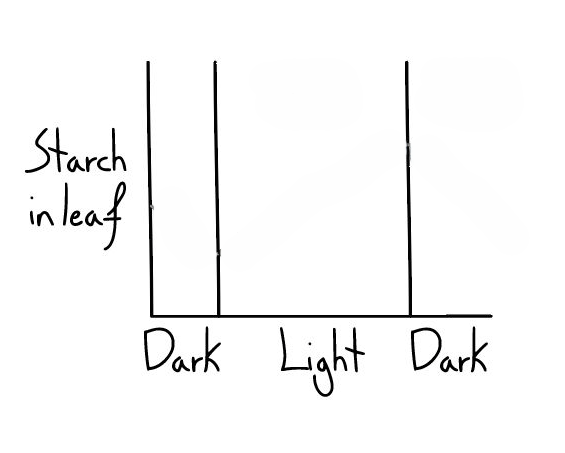
So, we’ve switched from the idea of “Carbon in plant” to glucose, and now to starch. For my students, this should all be a revision of the concept of organic molecules, so no problem. I ask them to draw a line on the graph in pairs (always in pencil so it can be rubbed out and corrected if needed).
I circulate, looking at the lines they’ve drawn, and then I give them mine. I now ask my students to explain my line in pairs before initiating a class discussion. The main aim is to note where photosynthesis is occurring faster and slower than respiration, which I eventually mark on the graph like this:
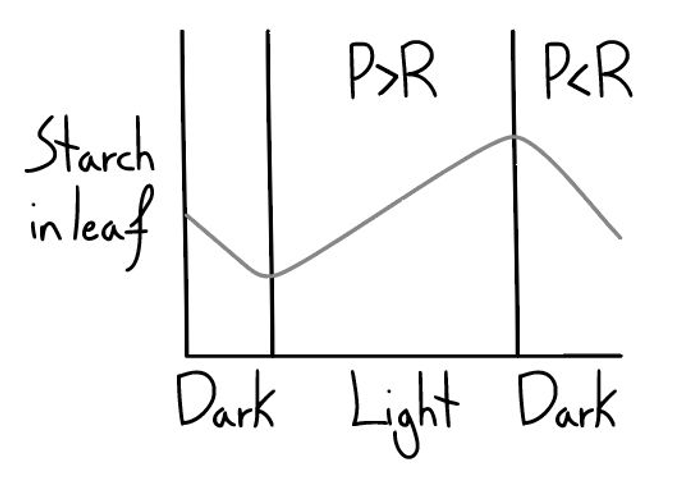
Depending on the curriculum and class, I may then use the same model to teach students about the limiting factors of photosynthesis. It’s a great opportunity to consider how agriculturalists can manipulate greenhouse conditions to enhance photosynthesis rates. Learn more about teaching, so students make meaning, in my books by clicking the covers below.