How I teach thermoregulation
As the content (sweating, shivering, & vasodilation) is relatively concrete, I could just tell my students their effects in isolation. For example, shivering causes heat gain when body temperature decreases. This alone is probably enough to gain some marks on an exam. But it would be a missed opportunity to develop understanding.
Research suggests that students are much more likely to consider inputs, but not outputs, from systems. Therefore, I begin here. I label the stock and have students suggest labels for the flows.
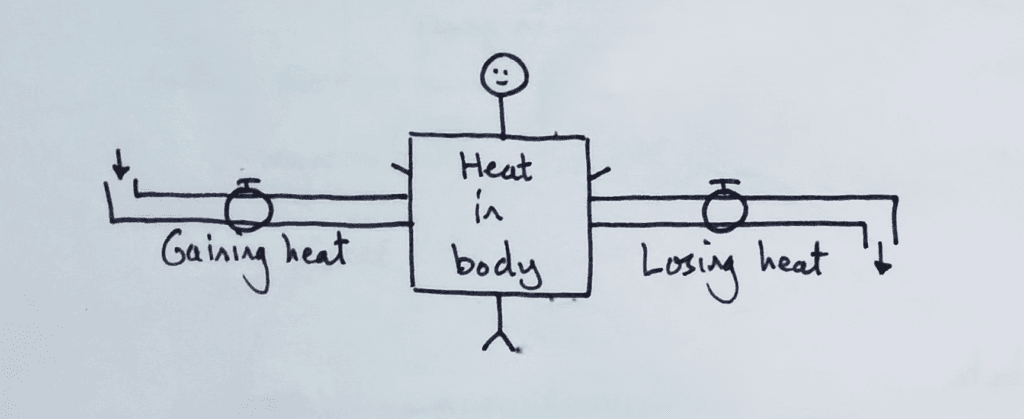
The only way to cause a change to the heat accumulated in the body is to adjust the inflow and outflow rates. If, gaining heat > losing heat, then heat will accumulate and vice versa. This is a key rule in stock and flow modelling, which allows students to rapidly understand models.
Logically, then, the next step is to ask students to identify the factors that affect the inflows and outflows. I ask them to discuss it in pairs for half a minute or so, before hearing their ideas.
With this example being familiar (through our embodied experience), it’s relatively easy to get some ideas from students, such as shivering and sweating. The key now is to have students make the distinction between those that act on heat gain and those that act on heat loss.
I give the students choices and have them vote. As I point to the flows, I ask, “Does sweating affect heat gain, or heat loss?” You’d be surprised. Some students vote for heat gain, and when I ask for their reasoning, they talk about how, when doing exercise, the sweating makes them hotter.
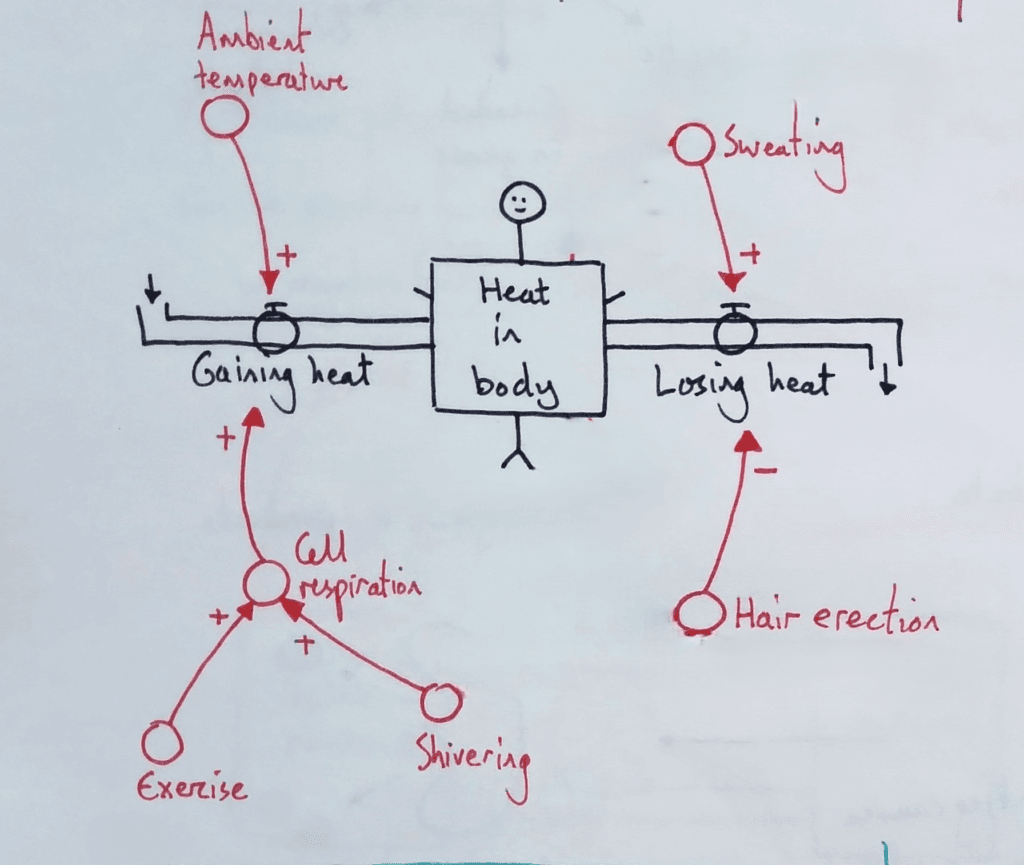
Next is to ask them for the direction of the effect. I dislike students using the phrase “it affects X” because it doesn’t say whether it is a positive or negative effect. To reveal this, we vote again. I point to the arrow and ask, “Is this same + (I wait for votes), or opposite – (I wait for votes)?”
⊕ means: ↑X, ↑Y; or ↓X, ↓Y, (I call these “Same”), e.g. more sweating → more heat loss.
⊝ means: ↑X, ↓Y; or ↓X, ↑Y, (I call these “Opposite”), e.g. more erect hair → less heat loss.
We do the same for shivering and hair erection (or goose bumps, as students like to say).
Next comes the interesting bit.
I ask students what causes the sweating/shivering. Many will suggest ambient temperature. So I give them an example, such as someone who is skiing in the Pyrenees. The ambient temperature is below zero degrees Celsius, but through activity and wrapped in thick clothing, they sweat.
The rule, of course, is that organisms must keep key variables within limits; homeostasis. For mammals, one of those key variables is body temperature. Humans can’t control the weather to control their body temperature; students must see that our adaptive ability is for controlling internal variables. Yet, confusion can arise from modern technology, such as controlling room temperature via air conditioning.
*In my simplified model, I decided to include ambient temperature as a factor affecting heat gain, but it could also affect heat loss in more elaborate models.
With this distinction made, we can complete the feedback loop, drawing the arrow from the stock (heat in body) to the response (sweating/shivering), and again, ask students if it is a “same” or “opposite” relationship. And the first loop is complete (I’ll add vasodilation and vasoconstriction later).
I ask students to follow the loop with me by placing their fingers on the model, and participating in call and response, something like this:
- The heat in the body increases, this causes… more sweating
- Sweating increases, so this causes… more heat loss
- Heat loss increases, so this causes… less heat in the body
Therefore, in a loop, an increase in body temperature ultimately leads to a decrease in body temperature. I have students vote on whether this is a negative or positive feedback loop. And I add the symbol to the model, before going through the same process for the other loops.
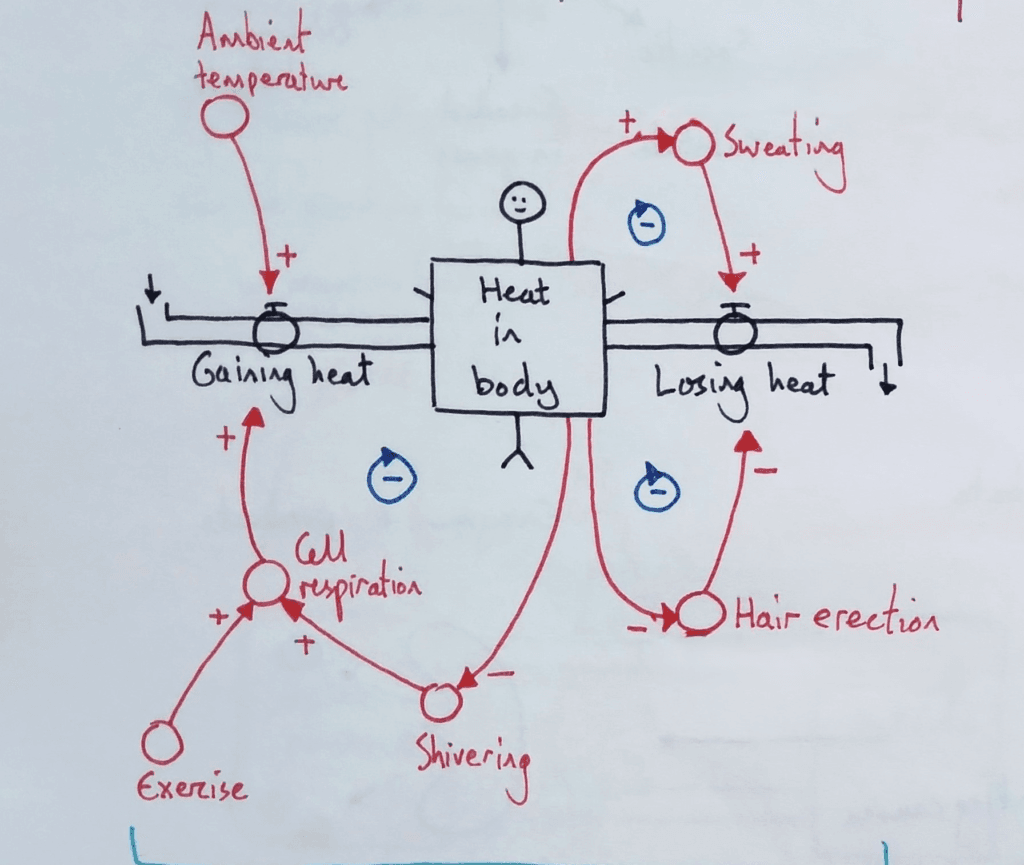
*I could add another separate loop between the heat in the body and cell respiration rate, but for this class I decided not to add this extra distinction to the model.
Now I want to include responses that students may know less about, and so I draw a diagram of the skin next to the model. And I discuss with the students the thermoregulatory responses of hair erection in mammals, and vasodilation and constriction.
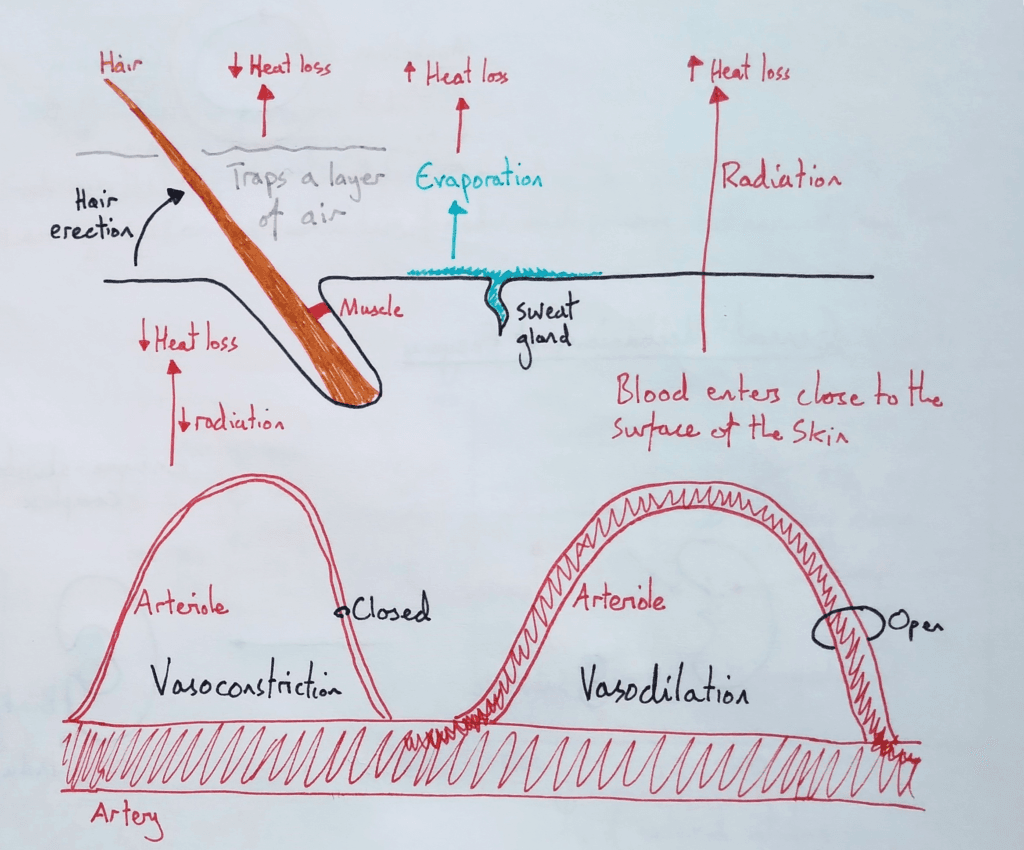
Having discussed and drawn this in concrete (bodily) terms, I ask students to attempt adding the responses to the model. They make some predictions, I walk the room to see them, and then I bring the class back to show them.
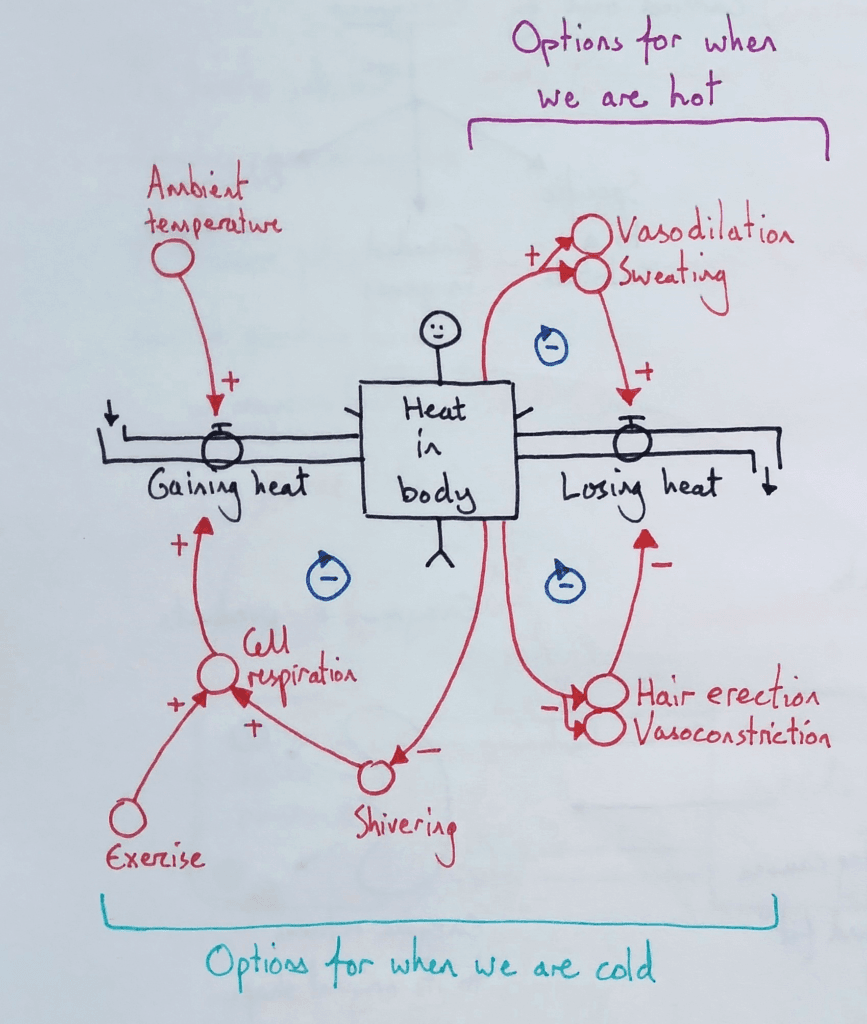
The model is now complete, and I give students some time to self-explain. This involves explaining a concept to yourself, as if to someone else, in your head. And I address any questions students have. From here, it’s time to practice *thinking with* the model through “What if?” questions (which I explain fully in my books, see Teaching Meaning).
Here’s a couple of “What if?” questions I’ve asked before:
- What if a person suffered a condition that caused permanent vasodilation?
- What if a person could only sweat half as much as a normal person?
Learn how to teach this way, freed from making and delivering powerpoints, in my books: