Models (14–16): Evolution
Evolution isn’t just a core theory of biology; it’s a way that biologists perceive biological content. Likewise, biology isn’t just content to memorise, it’s also fundamental to understanding who we are and our place in the world. As I argue in Biology Made Real, developing evolutionary thinking is key in two ways:
- It invites students to see the world as biologists do, and to enter into conversations with biologists.
- It invites them to understand their identity.
Often, however, evolution is left till last, taught alongside ecology as the final units of a course. This prevents students from regularly practising evolutionary thought. In my courses, then, evolution always comes early, and we discuss it often.
Cladograms
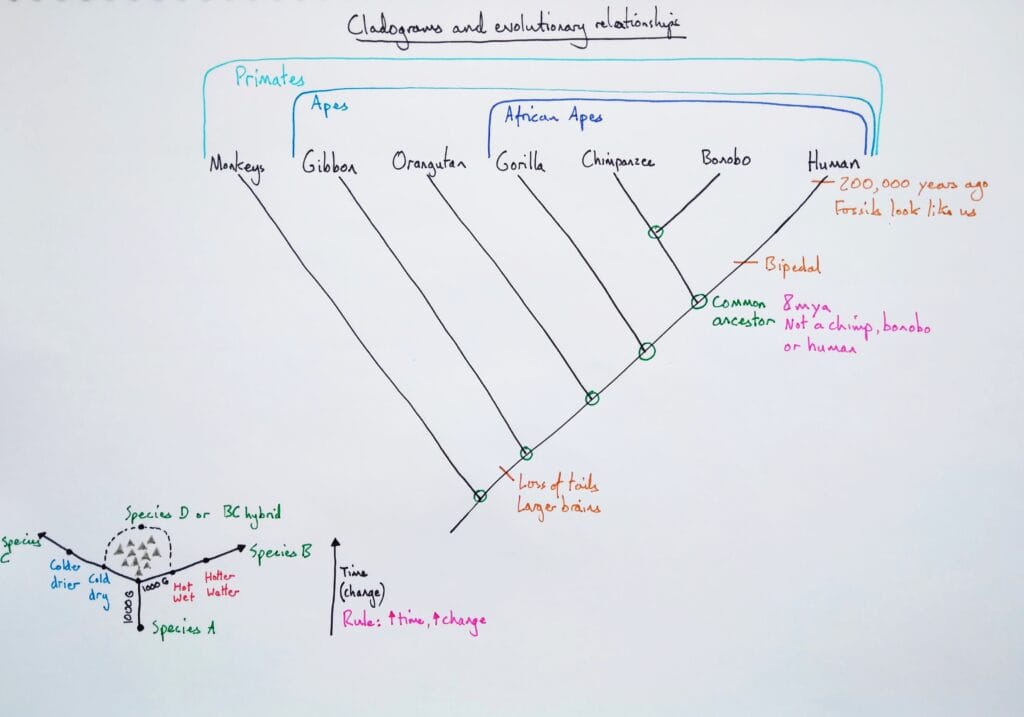
I begin this lesson with the cladogram in the bottom left (which I explain in Biology Made Real). The model combines the logic of cladograms with the accessible idea of migration and separation. I build it step by step and continually ask whether the population has diverged into two species or not. Then, we take the logic of cladograms to explore our closest living relations. The lesson culminates in pushing their evolutionary thinking deeper. Most students begin to think about evolutionary time as something happening in the past, but which has now settled on the current forms. We look at the fossils of our lineage since the divergence from the chimp-bonobo lineage. We look at Lucy, and I ask if Lucy was human. They don’t think she was, so we look at other fossils, and I ask them at what point they’re willing to say that they were “us”. I tell them that human fossils are said to be indistinguishable from ours 200,000 years ago (not long ago!). So, then, I ask, what will humans be like a few hundred thousand years in the future? Will they be “us”? Or will they be studying us as their funny-looking ancestors? Humanity, as they know it, is just the here and now. In evolution, the rule is change.
Natural Selection
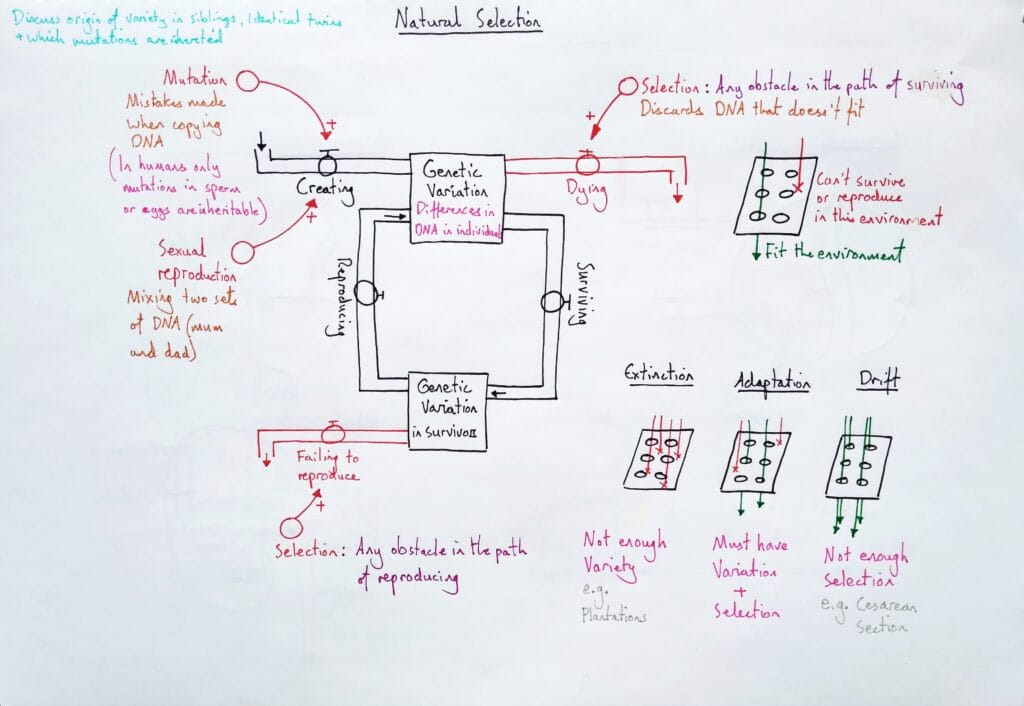
It typically takes me two lessons to build this model. I typically spend the first just discussing the idea of genetic variation and what is inheritable. In the second, I focus on selection and its consequences for populations. I explain this lesson in Difference Maker.
Learn how to teach-with students this way, freed from PowerPoints, in my books: