Does “checking for listening” help learning?
I’ve attended a couple of training sessions as a teacher in which the trainer would ask “check for listening” questions. They’d tell us things and then ask a question to someone chosen at random. “Seriously!?” I’d think, as the question triggered a resistance I suspect many students feel, too.
Checks for listening aren’t checks for understanding. They’re:
“High-frequency questions a teacher fires out at students, pretty much after every sentence of an explanation. The questions are designed for 100% of students to be able to answer successfully, provided they were paying attention.”1
I felt resistant not just because it was socially awkward, but because it treated me like a passive recipient to be filled. Attention is important, of course. But how we go about achieving it is key, and this depends on how we think about cognition.
I think “checking for listening” derives from a view of the brain as a receiver: obtain information, then act. Yet, as I’ll get to in a moment, modern cognitive science often sees the brain as an actor: act to perceive information. So, where does the “receiver” view come from?
In education, it’s classical cognitivism that has become popular. Here, the brain is described, often in diagrams, using computer metaphors: encoding, storing, and retrieving.
In these diagrams, information is seen to flow into the eyes and then into the brain’s memory. And from these models, it’s easy to think of the teacher as a regulator of information flowing into students’ minds.
For example, it’s sometimes said that “information flows into the system”.2 And that teaching has the problem of “choke points and pitfalls” that “constrain learning”. Attention is said to be “narrow”.
This metaphor can be read as a bandwidth story, just like uploading information to a computer. Maybe these diagrams are useful abstractions in certain situations. But there’s little biological evidence to support the idea of information flowing or step-by-step processing.3
This is where “checking for listening” comes in. Checking for listening makes sense if you see the teacher’s explanation as a stream of information and attention as the bottleneck. The argument goes that with every additional sentence a teacher says, attention wanes. In this sense, checking for listening realigns attention on the flow of information.4
Yet, contemporary cognitive science offers a different view: the brain isn’t a hard drive waiting to be filled. It’s an organ that evolved for action, not just moving, but acting to solve problems. Listening passively and just repeating what’s said isn’t just boring, it’s biologically unnatural. It’s not “information in, then react”. Instead, cognition is focused more on making inferences, predictions and choices, actions that allow us to understand information.5
So what does this mean for teaching?
Attention is still key, of course. But we shouldn’t be trying to hold our students’ attention to an information flow. There is no literal flow. And, not only is it socially irritating, it’s annoying because it doesn’t cohere with our cognitive drive to act with information.
Therefore, we’re likely to get better results if we try to prompt attention by having students act. Action here isn’t synonymous with movement. It involves making inferences and making choices; mental action.
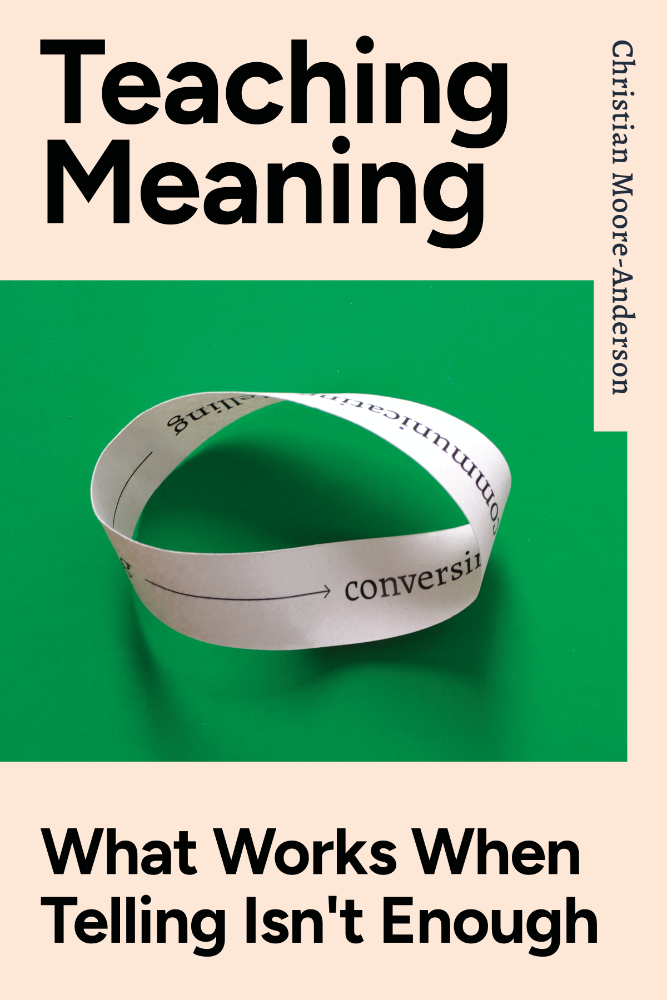
This changes how we view the “teacher explanation-student attention” model. Instead of continually “checking for listening” and having students repeat things. Attention is more likely to be achieved through having them make choices, predictions, and inferences during an explanation. As I explain in Teaching Meaning: What Works When Telling Isn’t Enough, we can ask such things as:
- What if this weren’t here, would A, B, or C happen?
- What if this weren’t true, would you see A or B?
- Why this and not this, what difference does it make?
This way, we prompt students to attend to our explanations through action. And we can engage students by giving them two of three choice answers to debate in pairs, before sharing with the class.
As they attend in this way, they actively make the explanation make sense to themselves as it’s being built. It’s a win-win scenario: students must actively bring forth the explanation (not just receive one), and in making choices, we can see their understanding and respond better to what they perceive.
Changing from “checking for listening” to prompting true mental action requires rethinking how we construct our explanations. To discover how to build these dynamic explanations and prompt better classroom conversations, check out my book: Teaching Meaning: What Works When Telling Isn’t Enough.

References
- https://bunsenblue.com/2023/04/08/checks-for-listening-100-participation/ ↩︎
- Chew, S. L. (2021) ‘An advance organizer for student learning: Choke points and pitfalls in studying.’ Canadian Psychology / Psychologie canadienne, 62(4), 420–427. ↩︎
- Varela, F., Thompson, E. and Rosch, E. (2016) The Embodied Mind: Cognitive Science and Human Experience. Revised edn. Ebook edn. MIT Press. ↩︎
- https://bunsenblue.com/2023/04/08/checks-for-listening-100-participation/ ↩︎
- Engel, A., et al. 2013. “Where’s the Action? The Pragmatic Turn in Cognitive Science.” Trends in Cognitive Science 17 (5): 202–9. ↩︎